
Professional CDR Writing Services for Engineers Australia: Complete Guide
Professional CDR Writing Services for Engineers Australia: Complete Guide
 choigen
Securing a positive migration skills assessment from Engineers Australia (EA) is the critical gateway for foreign engineers targeting Australian permanent residency. The Competency Demonstration Report (CDR) is not merely a record of past employment; it is an evidence-based technical portfolio proving your qualifications align with Australian professional standards.
In 2026, Engineers Australia’s Migration Skills Assessment (MSA) standards have tightened, particularly around automated content generation, cross-industry verification, and narrative authenticity. This comprehensive guide outlines the foundational architecture of an EA-approved CDR, common pitfalls to eliminate, and how professional CDR writing services streamline the pathway to a positive assessment.
1. Understanding the Engineers Australia CDR Assessment Framework
Engineers Australia assesses applications under four distinct occupational categories, each defining specific technical depth, accountability, and project contribution levels:
- Professional Engineer: Focuses on overall project management, engineering lifecycle innovation, design synthesis, and risk governance.
- Engineering Technologist: Emphasizes specialized technical application, engineering systems adaptation, and hands-on technology deployment.
- Engineering Associate: Directs focus toward technical procedures, routine operational maintenance, and practical engineering feasibility.
- Engineering Manager: Evaluates overarching strategy, operational governance, financial oversight, and enterprise leadership.
Critical Compliance Rule: Each pathway demands an exact alignment with the Australian Standard Classification of Occupations (ANZSCO) code selected. If the technical scope of your report misaligns with your targeted ANZSCO code, an immediate rejection or mandatory category downgrade will occur.
2. The Architecture of a High-Scoring CDR Report
A compliant CDR submission comprises four distinct technical components, each serving a specific evaluative function:
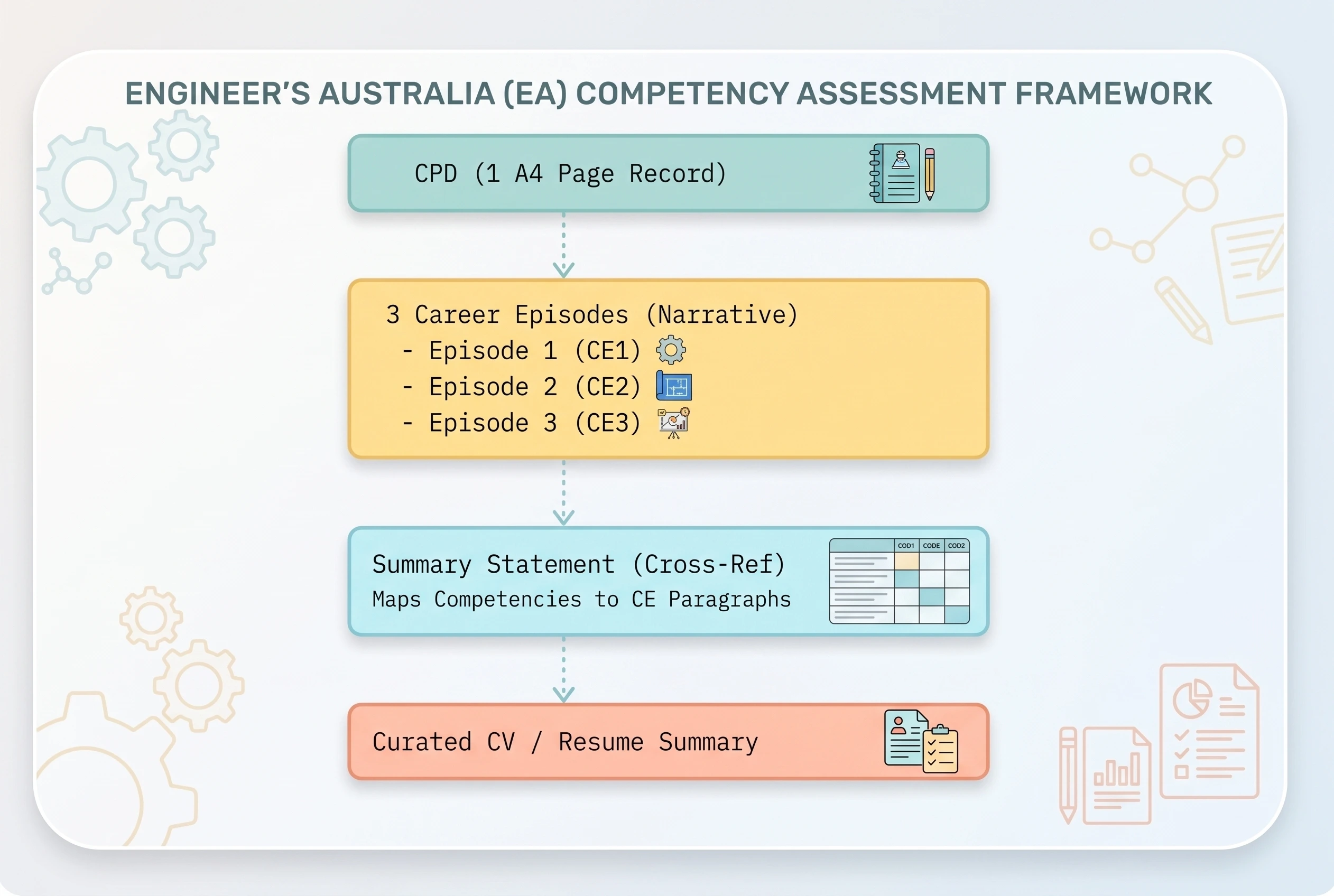
Continuing Professional Development (CPD)
The CPD provides a concise account of your ongoing technical development after graduation. It must be presented as a structured list on a single A4 page and include:
- Formal postgraduate coursework, industry certifications, or specialized software training
- Conferences, technical seminars, and engineering workshops
- Codes, design manuals, and professional technical journals
- Voluntary or community-oriented technical and engineering services
Three Distinct Career Episodes
The Career Episodes (CEs) are the backbone of the entire assessment. Each episode must narrate an individual engineering project or a distinct problem-solving phase of your professional journey:
- CE1: Academic or Early-Career Project: Often drawn from final-year capstone engineering research or early foundational roles.
- CE2: Professional Implementation Project: Focuses on standard field deployment, client-driven technical deliverables, and procedural compliance.
- CE3: Advanced Problem-Solving Project: Emphasizes technical novelty, complex troubleshooting, system design, and resource optimization under constraints.
Each episode must range between 1,000 to 2,500 words and strictly adhere to a numbered paragraph convention (e.g., Paragraph 1.1, 1.2, 2.1, 2.2).
The Summary Statement (SS)
The Summary Statement directly maps individual paragraphs from your three Career Episodes to the specific competency elements listed in the Engineers Australia MSA booklet. Depending on your occupation category, you must satisfy all elements across four competency units: Knowledge and Skill Base, Engineering Application Ability, and Personal and Professional Attributes.
Verified Curriculum Vitae (CV)
A chronological, detailed summary of your career containing employer details, dates, key responsibilities, and performance outcomes, mirroring the engineering achievements described within the episodes.
3. Step-by-Step Breakdown: Drafting High-Impact Career Episodes
Engineers Australia assesses your individual contribution, not the broader achievements of your team or organization. Follow this paragraph-by-paragraph breakdown to ensure structural compliance:
| Section | Target Length | Core Technical Focus | Mandatory Elements |
|---|---|---|---|
| Introduction | ~100 words | Project chronics, operational dates, geographic location, employing organization. | Chronological clarity, institutional identity, project title. |
| Background | 200–500 words | Business context, project objectives, exact organizational chart indicating your hierarchy. | Clear reporting hierarchy, functional seat, organizational context. |
| Personal Engineering Activity | 500–1,250 words | Concrete technical execution, formulas, software used, challenges, and design implementations. | First-person active voice: “I designed…”, “I calculated…”, “I mitigated…”. |
| Summary | 50–100 words | Project closure, deliverables completion, targets achieved, peer/client validation. | Measurable engineering metrics (e.g., “Reduced thermal drift by 14%”). |
Navigating the Personal Engineering Activity Section
The core of each Career Episode is your personal engineering activity. To meet EA standards:
- Frame Technical Decisions Explicitly: State why you chose a specific methodology. If you designed a structural support, specify the software used (e.g., Pro, ANSYS), the Australian or international design codes applied (e.g., AS/NZS 1170), and the exact loading conditions you calculated.
- Address Engineering Challenges Directly: Describe instances where things went wrong—a component failure, thermal stress, or site delay. Detail how you personally diagnosed the root cause, ran simulations, and deployed an engineering remedy.
- Highlight Safety and Risk Management: Explicitly mention safety protocols, environmental impact assessments, and operational risk mitigation procedures applied during the project lifecycle.
4. Summary Statement Architecture: Precision Mapping
The Summary Statement is an indexed table that cross-references EA competency units with your Career Episodes. A generic or unverified Summary Statement is one of the fastest routes to an assessment delay.
Example Competency Element Mapping:
Competency Element: PE 2.2 Fluent application of engineering techniques, tools and resources.
Narrative Mapping: “I applied dynamic FEA modeling using ANSYS to identify high-stress concentration zones across the rotor assembly, reducing shear risk under cyclical loads.” → Mapped to: Career Episode 2, Paragraphs 2.3.4 and 2.3.5.
Every claim made in the Summary Statement matrix must point directly to a concrete, identifiable technical action inside your numbered Career Episode paragraphs.
5. Critical Traps That Trigger Engineers Australia Rejections
Even qualified engineers frequently receive an assessment rejection or a request for rework. Avoid these major compliance errors:
- Overusing “We” Instead of “I”: EA evaluators are not assessing your team; they are assessing your personal competency. Phrasing such as “We finalized the piping layout” conceals your contribution. Write: “I finalized the piping layout using AutoCAD Plant 3D and verified flow pressure against design tolerances.”
- Relying on AI-Generated Content: In 2026, Engineers Australia utilizes specialized linguistic and stylistic detection models to catch AI-generated content. Generic, repetitive, or synthetic project descriptions are immediately flagged, often resulting in application cancellations and multi-year application bans.
- Failing the Technical Plagiarism Threshold: EA uses advanced cross-comparison algorithms against an expansive database of previously submitted global reports. Copying text from online project repositories, peer reports, or published academic theses results in an outright plagiarism penalty.
- Vague Technical Context: Writing extensive high-level summaries without including engineering formulas, specifications, design limits, and operational metrics suggests a lack of real involvement in the project.
- Ignoring the ANZSCO Code Scope: Writing an episode focused on routine maintenance workflows when applying under the Professional Mechanical Engineer (ANZSCO 233512) classification will likely result in your experience being marked as non-compliant with the targeted professional level.
6. Why Work with Professional CDR Writing Services?
Preparing a successful CDR requires translating years of complex engineering activities into a strictly formatted document that meets Migration Skills Assessment criteria. Partnering with a dedicated service like cdrwritersaustralia.com provides critical advantages:
- Domain-Specific Engineering Writers: Work with technical specialists who understand your exact engineering discipline—from electrical, civil, and mechanical to biomedical and telecommunications.
- Rigorous Alignment with 2026 EA Guidelines: Reports are drafted around the latest changes to EA assessment criteria, documentation formats, and evidence thresholds.
- Zero Plagiarism Guarantee: Every section of your report is built from your authentic career history and run through enterprise-grade similarity and code-checking platforms before finalization.
- Comprehensive Quality Audits & Editing: Experienced editors audit your engineering narratives, verify paragraph numbering, and ensure your Summary Statement directly backs every competency claim.
- End-to-End Delivery: Get comprehensive support across your entire application package—including your CV, CPD listing, all three Career Episodes, and the completed Summary Statement.
7. Frequently Asked Questions (FAQ)
Can I submit academic projects in my Career Episodes?
Yes. Academic projects, laboratory research, and final-year capstone theses can be used for your Career Episodes, particularly if you have limited post-graduation industry experience. However, they must showcase your independent technical contributions, design decisions, and practical problem-solving.
How long does Engineers Australia take to assess a CDR in 2026?
Standard processing typically takes between 8 to 12 weeks. Fast-track processing options generally yield assessment outcomes within 15 to 20 business days, provided EA does not require additional information or project clarifications.
What happens if Engineers Australia flags plagiarism in my report?
If EA detects plagiarized or unverified content, they will issue an official notice requiring explanation. Unless you provide compelling justification, your application will be rejected, your fees forfeited, and you may face a mandatory 12 to 36-month ban from reapplying for skills assessment.
Can I manage my CDR submission if my degree is non-accredited?
Yes. The CDR pathway exists specifically for engineers holding qualifications from non-accredited institutions or countries outside the Washington, Sydney, or Dublin Accords. It is your formal avenue to demonstrate that your skills meet Australian standards.