
CDR Technical Interview Preparation: How to Explain Your Career Episodes to Engineers Australia

CDR Technical Interview Preparation: How to Explain Your Career Episodes to Engineers Australia
 choigen
Navigating the Migration Skills Assessment (MSA) process with Engineers Australia (EA) can feel like a rigorous technical audit. For skilled engineers migrating to Australia, submitting a high-quality Competency Demonstration Report (CDR) is the central pillar of the skills assessment journey.
Engineers Australia assessors frequently conduct follow-up technical interviews or competency verification discussions. This occurs when assessors need to confirm the authenticity of your submission, verify your direct involvement in complex engineering tasks, or evaluate your command of core engineering fundamentals.
Knowing how to structure your answers around your written Career Episodes and articulate solutions to complex engineering project questions is critical to securing a positive skills assessment outcome.
This comprehensive guide breaks down essential CDR technical interview preparation techniques, detailing how to explain your Career Episodes and navigate demanding engineering project questions during your assessment.
Why Is the Engineers Australia Technical Interview Conducted?
The primary objective of Engineers Australia during a technical assessment or clarification interview is to verify that the engineering knowledge and problem-solving skills presented in your submission reflect your actual capability.
During the evaluation of a Competency Demonstration Report, assessors look beyond well-written prose. They evaluate your individual technical depth, professional integrity, and practical application of engineering principles.

A technical interview or verification call is usually triggered for several specific reasons:
- Plagiarism or AI Content Audits: Verifying that your written report is entirely original and represents your genuine professional output.
- Clarifying Personal Contribution: Identifying your exact duties when a project report heavily uses collective terminology like “we performed” or “our team designed”.
- Testing Technical Depth: Ensuring you can explain calculations, software tools, design codes, and engineering methodologies mentioned in your submission.
- Resolving Discrepancies: Addressing inconsistencies between your CV, reference letters, and written project narratives.
Effective CDR technical interview preparation ensures you are never caught off-guard when asked to break down your Career Episodes or address deep-dive engineering project questions.
Understanding Your CDR Framework: The Foundation of Your Interview
To excel in your interview, you must thoroughly understand the three fundamental components of your Competency Demonstration Report:
- Continuing Professional Development (CPD): A structured list showing how you maintain up-to-date knowledge in your engineering discipline through training, workshops, and self-study.
- Three Career Episodes: Independent, narrative-based accounts of your distinct engineering projects, detailing how you applied your knowledge to solve complex technical problems.
- Summary Statement: A cross-referenced mapping matrix that links specific paragraphs from your project reports to Engineers Australia’s Stage 1 Competency Standards.
Because your interview centers on these elements, structured CDR technical interview preparation begins by reviewing the exact paragraph numbering (e.g., Paragraph 1.3, 2.3, 3.3) of your Career Episodes.
🔥 If you require guidance on refining your initial documentation before submission, exploring CDR Writers Australia can help align your reports with Engineers Australia guidelines. 🔥
Step-by-Step Guide: How to Present Your Career Episodes to Engineers Australia
When an assessor asks you to walk through your Career Episodes, they are not looking for a general summary of the company’s project.
Follow this structured framework to present your narratives effectively:
1. State the Context Concisely
Spend no more than 60 to 90 seconds setting up the background. State the project title, location, duration, employing organization, and your specific role.
“In my first Career Episode, I focused on my role as a Structural Project Engineer for the North River Bridge Rehabilitation in 2024. My primary responsibilities involved structural modeling, finite element analysis, and designing retrofitting schemes.”
2. Dive Straight into Personal Engineering Activities
The core of your answer must highlight personal engineering actions. Use clear, first-person action verbs such as “I calculated,” “I modeled,” “I diagnosed,” and “I standardized.”
During your CDR technical interview preparation, practice answering these core prompts regarding your Career Episodes:
- What specific engineering theories did you apply?
- Which formulas or mathematical models did you use?
- What software tools (e.g., ANSYS, ETABS, MATLAB, AutoCAD) did you operate, and why?
- Which local or international engineering standards (e.g., AS/NZS, ISO, IEEE, ASME) guided your design decisions?
3. Emphasize Problem-Solving and Technical Challenges
Engineers Australia assessors place immense weight on how candidates approach technical obstacles. When describing your Career Episodes, dedicate a significant portion of your response to explaining an engineering problem you personally solved.
Structure your problem-solving narrative using the STAR Method (Situation, Task, Action, Result):
| STAR Element | Objective | What to Say in Your Interview |
|---|---|---|
| Situation | Define the technical issue | “During non-destructive testing, we detected unexpected micro-fractures in the primary load-bearing joints.” |
| Task | Define your personal duty | “I was tasked with identifying the root cause and engineering a reinforcement solution without increasing the dead weight.” |
| Action | Detail your technical steps | “I conducted a stress distribution analysis in ANSYS, calculated revised load factors using AS 5100 standards, and designed welded gusset plates.” |
| Result | Quantify the positive outcome | “My solution restored structural integrity, satisfied safety margins, and completed two weeks ahead of schedule.” |
By mastering this narrative structure during your CDR technical interview preparation, you will present your Career Episodes with clarity and authority.
How to Prepare for Technical Engineering Project Questions
Assessors routinely ask deep engineering project questions to test whether you truly possess the technical knowledge described in your reports. These questions test your fundamental engineering intuition and practical knowledge.
To ensure thorough CDR technical interview preparation, categorize potential engineering project questions into four core domains:

Domain 1: Engineering Fundamentals & Calculation Logic
Assessors may ask you to explain the basic mathematical or physical principles underlying your project decisions.
- Typical Questions:
- “Why did you choose this specific material grade for your component?”
- “How did you determine the safety factor used in your stress calculations?”
- “What primary equations governed your fluid flow or heat transfer simulations?”
How to Answer: Walk the interviewer through your step-by-step logic. Explain the assumptions you made, the boundary conditions you set, and how safety factors were integrated to prevent failure modes.
Domain 2: Software Modeling and Numerical Simulations
If your Career Episodes cite specialized software applications, prepare for targeted engineering project questions regarding your software inputs and output validation.
- Typical Questions:
- “How did you validate the results generated by your software simulation?”
- “What mesh density or discretization parameters did you apply in your model?”
- “Did you cross-check your automated software outputs with hand calculations?”
How to Answer: Never claim that you simply “plugged numbers into software.” Emphasize that software is a verification tool, and explain how you validated software outputs using analytical hand calculations, simplified empirical formulas, or physical testing.
Domain 3: Codes, Safety, and Compliance Standards
Engineers in Australia operate under strict regulatory frameworks and safety codes.
- Typical Questions:
- “Which specific standards guided your design process?”
- “How did you incorporate environmental risk management into your design?”
- “What safety protocols did you establish before conducting site testing?”
How to Answer: Mention relevant national or international design codes (such as AS/NZS, ISO, Eurocodes, or IEEE standards). Detail how compliance with these standards ensured environmental protection, operational safety, and structural reliability.
Domain 4: Project Management and Risk Mitigation
Assessors also evaluate your project management competence, safety awareness, and ethical decision-making.
- Typical Questions:
- “How did you manage unexpected project delays or budget constraints?”
- “What risk assessment framework did you use on the job site?”
- “How did you handle a technical disagreement with a senior engineer or contractor?”
How to Answer: Highlight systemic approaches like Risk Assessment Matrices, HAZOP studies, or structured change-management workflows. Demonstrate professional leadership, ethical practice, and clear communication.
Critical Interview Do’s and Don’ts
To ensure your CDR technical interview preparation leads to a positive outcome, keep these essential practices in mind when explaining your Career Episodes and answering engineering project questions:
- DO use first-person language (“I”): Always frame your answers around what you personally calculated, designed, or executed.
- DO NOT use passive team phrasing (“We”): Overusing “we” makes it impossible for assessors to isolate your personal engineering contribution.
- DO re-read your entire CDR before the interview: Know your report inside and out, including paragraph numbers, project dates, and design details.
- DO NOT memorize answers verbatim: Focus on understanding the core engineering principles of your projects so you can adapt naturally to probing questions.
- DO explain your design rationale: Always state why you chose a specific design, material, or software tool over alternatives.
Tailored Preparation Strategy by Engineering Discipline
Different engineering fields require unique focus areas during CDR technical interview preparation. Tailor your preparation based on your ANZSCO occupational classification:
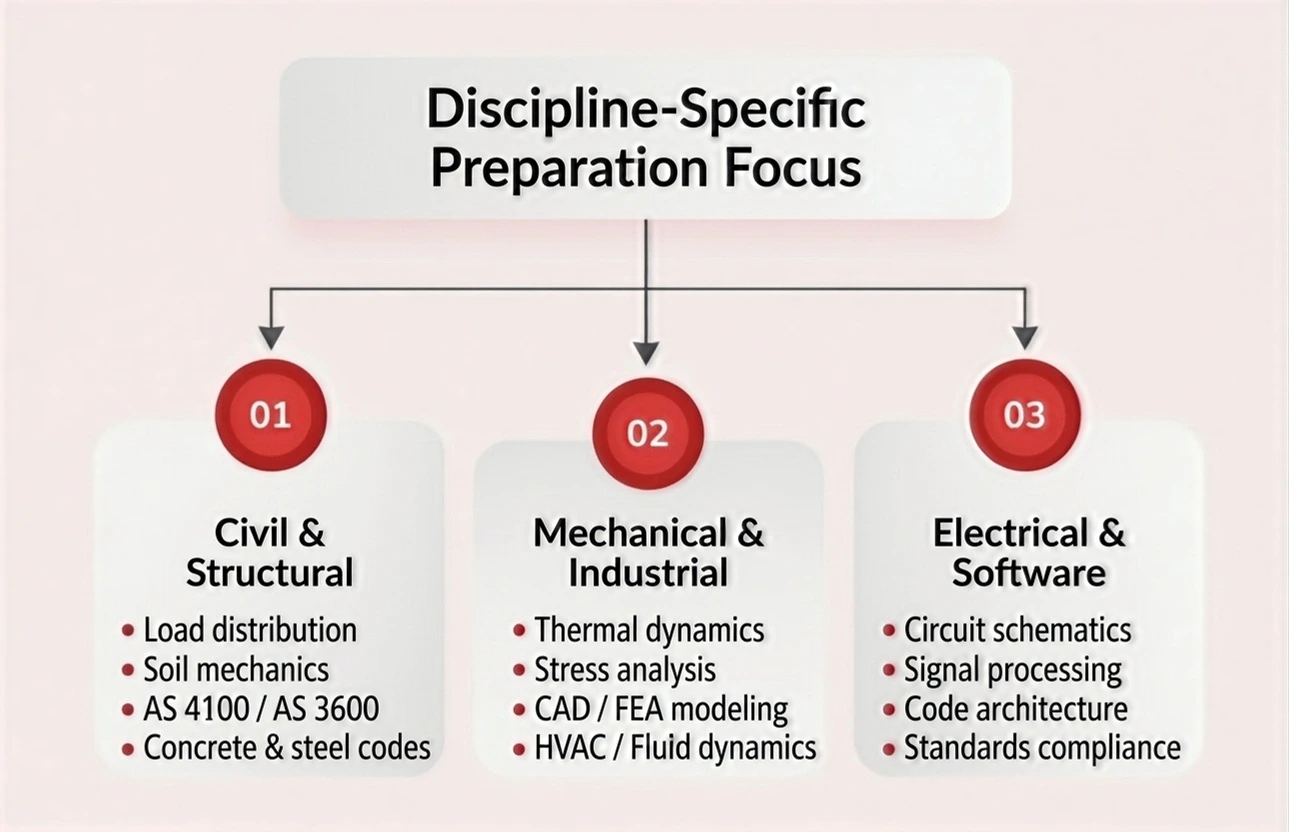
Civil & Structural Engineers
- Key Focus: Load calculations (dead, live, wind, seismic loads), soil mechanics, concrete/steel design codes (AS 3600, AS 4100), foundation analysis, and site safety.
- Interview Tip: Be prepared to write or walk through basic load distribution calculations and justify your choice of structural software (e.g., Space Gass, ETABS, STAAD Pro).
Mechanical & Materials Engineers
- Key Focus: Thermodynamics, fluid dynamics, stress analysis, CAD modeling, HVAC design, machine components, and manufacturing processes.
- Interview Tip: Expect questions on finite element analysis (FEA) mesh refinement, material yield strength calculations, and heat exchanger sizing formulas.
Electrical & Electronics Engineers
- Key Focus: Circuit design, power systems analysis, high/low voltage protection schemes, signal processing, PLC programming, and electrical safety standards.
- Interview Tip: Practice explaining single-line diagrams, voltage drop calculations, relay protection settings, and compliance with AS/NZS 3000 wiring rules.
Software & Telecommunications Engineers
- Key Focus: System architecture, algorithm optimization, network topologies, database design, software development lifecycles (SDLC), and data security protocols.
- Interview Tip: Be ready to defend system design decisions, data flow diagrams, API integration strategies, and software testing procedures.
Common Pitfalls That Lead to Interview Rejections
Failing a technical interview or verification call usually stems from a few avoidable mistakes. Understanding these pitfalls is a crucial part of your CDR technical interview preparation:
- Inconsistency with Written Reports: If your spoken explanation of a project contradicts the technical details in your written Career Episodes, assessors will flag your file for authenticity concerns.
- Inability to Explain Calculations: Claiming complex design calculations in your CDR but failing to explain fundamental mathematical formulas during the interview triggers negative evaluations.
- Over-reliance on Team Accomplishments: Repeatedly describing what “the project team achieved” rather than your specific engineering contributions leads assessors to conclude you lacked hands-on technical responsibility.
- Unfamiliarity with Cited Standards: Listing local or international engineering standards in your summary statement without knowing how they applied to your actual work creates a major competency gap.
Professional Assistance for Your Assessment Journey
Preparing for your skills assessment requires meticulous effort, technical accuracy, and adherence to Engineers Australia guidelines. Professional guidance can streamline your preparation process:
- Comprehensive CDR Writing: Ensure your project reports strictly conform to Engineers Australia standards from day one. Learn more about tailored end-to-end report preparation through our CDR Writing Services.
- Career Episode Review: Receive detailed feedback on narrative structure, active-voice phrasing, and competency alignment. Explore specialized Career Episode Writing Assistance to ensure your technical reports present your individual engineering work accurately.
- Summary Statement Mapping: Ensure every paragraph in your episodes is accurately mapped to Stage 1 Competencies. Check out dedicated Summary Statement Services for expert mapping support.
- Plagiarism and AI Verification: Validate your report’s originality using advanced diagnostic audits before formal submission.
🔥 Review our comprehensive CDR Review and Proofreading Services to submit your application with confidence. 🔥
Conclusion
Securing a positive Migration Skills Assessment outcome from Engineers Australia opens up valuable pathways for professional practice and migration. Thorough CDR technical interview preparation transforms potential interview anxiety into a structured opportunity to highlight your expertise.
By mastering your Career Episodes, practicing first-person active narrative delivery, and systematically reviewing technical engineering project questions, you can defend your report with clarity and confidence.
Frequently Asked Questions (FAQs)
1. Does every candidate have to attend an interview with Engineers Australia?
No. Technical interviews or verification calls are not mandatory for all applicants. They are typically requested when assessors need to verify document authenticity, clarify vague personal contributions, or test specific engineering knowledge presented in your submission.
2. How long does a typical Engineers Australia technical interview last?
A verification or technical assessment interview usually lasts between 30 and 60 minutes. The session focuses heavily on your Career Episodes and technical engineering project questions.
3. Can I refer to my written CDR during the technical interview?
Yes. You are expected to be familiar with your submitted report. Having a copy of your Career Episodes and supporting calculation sheets open for reference during an online interview is acceptable and recommended.
4. What language should I use during the interview?
The interview is conducted entirely in English. Assessors evaluate both your technical competence and your ability to communicate effectively in a professional Australian engineering environment.
5. What happens if I cannot answer a specific technical question?
Do not panic or guess blindly. Briefly explain the general engineering principles related to the topic, acknowledge the limits of your immediate memory, and describe how you would research or calculate the solution on the job site.