
CDR Resubmission After Rejection: Complete Guide
 choigen
Receiving a rejection letter from Engineers Australia (EA) regarding your Competency Demonstration Report (CDR) can feel like a major roadblock on your journey toward Australian skilled migration. Thousands of global engineering professionals successfully secure a positive migration skills assessment every year by pursuing a strategic, rigorous approach to CDR resubmission.
Understanding why Engineers Australia rejected your initial report, deciphering complex assessor comments, and executing an error-free CDR resubmission after rejection are the critical steps needed to turn a refusal into an official approval. A rejected CDR resubmission is not simply a matter of correcting minor typos or rephrasing a few sentences;
It demands a thorough re-evaluation of your technical narrative, individual contribution markers, competency cross-referencing, and structural compliance with the latest Migration Skills Assessment (MSA) standards.
This comprehensive guide breaks down the complete workflow for navigating a rejected CDR resubmission, providing actionable steps to eliminate structural, ethical, and technical errors. Whether your application was turned down due to perceived plagiarism, lack of individual engineering design, incorrect ANZSCO code selection, or a flawed Summary Statement.
If you need professional guidance to understand complex assessor feedback and turn it into a compliant, well-structured submission, seek expert support from CDR Writers Australia, offering specialized CDR Writing Services designed around Engineers Australia’s assessment requirements.
Understanding the Engineers Australia Evaluation Process
To execute a successful CDR resubmission, you must first understand how Engineers Australia evaluates migration skill assessment applications. The Competency Demonstration Report is a portfolio-style assessment consisting of four mandatory core components:
- Continuing Professional Development (CPD): A structured log proving that you have actively maintained and expanded your engineering knowledge through postgraduate study, short courses, technical seminars, workshop attendance, and workplace training.
- Three Career Episodes: Narrative reports detailing specific engineering projects or tasks where you personally applied your academic knowledge and professional skills.
- Summary Statement: A single, highly organized cross-referencing matrix that explicitly links the competency indicators outlined in the EA MSA Booklet to specific, numbered paragraphs within your three Career Episodes.
- Curriculum Vitae (CV) / Resume: A complete, chronological account of your academic history and professional work experience, strictly matching your official employment references and tax/payroll evidence.
A rejected CDR resubmission must methodically resolve every point raised in that correspondence rather than making superficial, cosmetic updates.
Primary Causes of CDR Rejection by Engineers Australia
Identifying the underlying cause of your assessment failure is the essential first step toward preparing an accurate CDR resubmission after rejection. Based on thousands of assessed cases, Engineers Australia assessors typically flag applications for the following primary reasons:
1. Plagiarism and Unauthorized Use of Online Samples
Plagiarism is a major cause of CDR rejection. Engineers Australia uses advanced checks to detect similarities with online sources, academic papers, sample databases, and previous CDRs.
If an assessor detects plagiarized content, even if it represents a small fraction of a Career Episode, the application is rejected immediately. Furthermore, EA often imposes a mandatory 12- to 36-month ban under its ethical policy.
2. Excessive Focus on Team Achievements (Overuse of “We”)
Career Episodes must showcase your individual contribution to an engineering project. A major pitfall for international applicants is describing the overall project team’s accomplishments rather than their personal responsibilities.
Using collective phrasing such as “We designed the structural layout,” “Our team calculated the hydraulic pressure,” or “We managed the commissioning phase” makes it impossible for the EA assessor to discern your specific role.
To achieve a positive outcome in a CDR resubmission, narratives must be written in the first-person singular active voice (“I designed,” “I calculated,” “I investigated,” “I modeled”).
3. Misalignment with the Selected ANZSCO Code
Every CDR must be tailored to a specific occupation code under the Australian and New Zealand Standard Classification of Occupations (ANZSCO). Selecting an ANZSCO code that does not match your core educational background or work duties leads to rejection or an automatic category downgrade.
For example, if you nominate Civil Engineer (ANZSCO 233211) but your Career Episodes focus on site administration, budgeting, and basic safety checks rather than structural calculations or concrete design, the assessor may find that your experience does not align with the nominated occupation.
4. Lack of Technical Engineering Substance and Calculations
Engineers Australia is assessing your ability to solve complex, non-routine engineering problems. A very common reason for a CDR resubmission request is that the Career Episodes read like general project overviews or administrative construction logs. Assessors want to see:
- Concrete mathematical formulas, design calculations, and simulation models.
- Specific engineering software tools utilized (e.g., MATLAB, ANSYS, ETABS, SolidWorks, AutoCAD, Primavera).
- Relevant national and international engineering standards referenced and applied (e.g., AS/NZS, ISO, Eurocodes, ASTM).
- Diagnostic workflows used to identify, analyze, and resolve technical failures.
5. Summary Statement Cross-Referencing Errors
The Summary Statement is the central bridge of your application. Assessors frequently reject reports when the Summary Statement contains non-functional cross-references. If your Summary Statement claims that paragraph 2.3.4 demonstrates your mastery of risk management but paragraph 2.3.4 in your Career Episode actually describes meeting minutes or general site visits, the alignment fails. In a rejected CDR resubmission, every cross-reference must be checked for strict logical accuracy.
6. Formatting, Word Count, and Structural Violations
The MSA Booklet sets clear formatting requirements. Career Episodes should stay within the required word range, while consistent paragraph numbering, such as 1.1, 1.2, 1.3 for Episode 1, helps assessors review the document efficiently.
Step-by-Step Roadmap for CDR Resubmission After Rejection
Executing a successful CDR resubmission after rejection requires a structured, step-by-step approach. Skipping steps or rushing to re-upload modified files without systematic verification almost guarantees a second refusal.
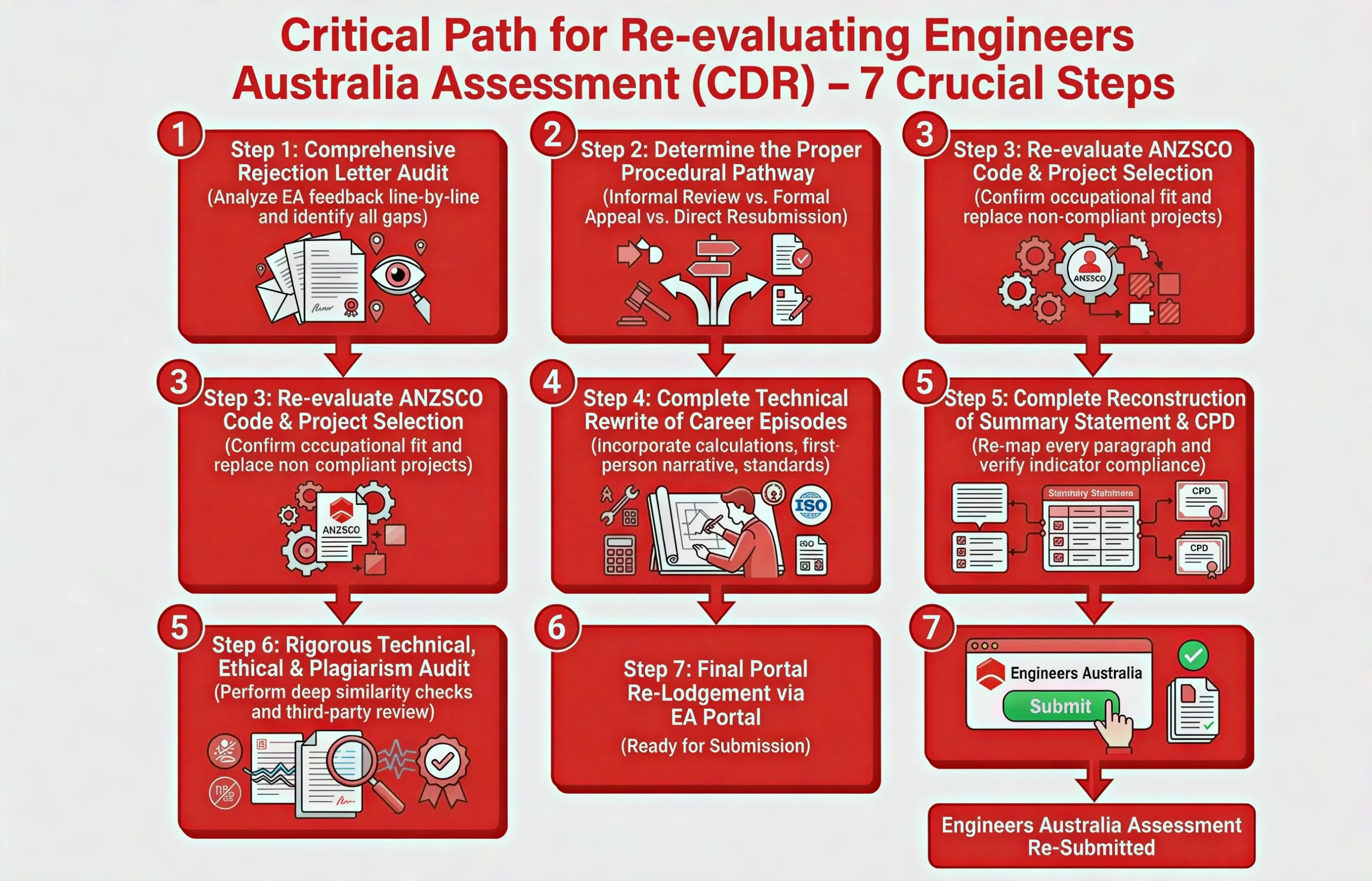
Step 1: Comprehensive Rejection Letter Audit
If you receive a refusal notice, avoid making changes to your documents straight away. First, review your official Engineers Australia outcome letter carefully and note down each specific comment or concern raised by the assessor. Group the feedback into distinct categories:
- Structural Issues: Paragraph numbering, section hierarchy, word count limits.
- Technical Deficiencies: Missing design calculations, lack of software application, insufficient problem-solving narrative.
- Personal Ownership Deficiencies: Passive voice, overuse of team terminology.
- Ethical/Plagiarism Concerns: Flagged similarity, unverified claims, template matches.
Step 2: Determine the Proper Procedural Pathway
Engineers Australia provides defined administrative mechanisms depending on the nature of the rejection:
- Informal Review Application: If you believe an administrative mistake occurred or that relevant evidence from your original application was overlooked, you may request an Informal Review within 3 months of the outcome date.
- Formal Appeal: If the Informal Review does not resolve the matter satisfactorily, you may submit a Formal Appeal within 6 months from the date of the original decision.
- Direct CDR Resubmission: If the initial submission contains significant technical gaps, structural issues, weak presentation, or copied material, requesting a review without addressing these underlying problems is unlikely to produce a favorable result.
Step 3: Re-evaluate ANZSCO Code and Project Selection
If the assessor indicated that your work experience does not align with your chosen ANZSCO code, re-assess your options.
You may need to either re-target a more appropriate ANZSCO code that matches your actual work experience or completely replace weak Career Episodes with stronger academic or professional projects that clearly showcase the required ANZSCO competencies.
Step 4: Complete Technical Rewrite of Career Episodes
When preparing your Career Episodes for a rejected CDR resubmission, restructure the content carefully and follow a systematic approach:
- Introduction: State project title, dates, location, employing organization, and your exact professional role.
- Background: Introduce the project by explaining its purpose, organizational structure, your position within the team, and the responsibilities assigned to you.
- Personal Engineering Activity: This is the core technical heart of the episode. Explain in explicit detail how you solved engineering problems.
- Summary: Briefly summarize the overall project outcome and highlight how your personal contributions led to project success.
Step 5: Reconstruction of the Summary Statement and CPD
Once the Career Episodes are rewritten, rebuild your Summary Statement line-by-line. Read each competency element in the MSA Booklet and verify that the cited paragraph in your Career Episode provides explicit, undeniable proof of that capability. Concurrently, update your CPD table to ensure it covers recent technical learning, industry seminars, software training, and professional memberships.
Step 6: Rigorous Technical, Ethical, and Plagiarism Audit
Run your complete file set through advanced similarity detection software. Ensure that every sentence is completely original, written in proper technical English, and free from external sample fragments.
For a complete, unbiased evaluation prior to re-lodgement, consider utilizing the CDR Review Services at CDR Writers Australia to catch subtle technical flaws before EA assessors inspect your files.
Detailed Comparison: Initial Submission vs. Strategic Resubmission
To visualize how your mindset and documentation must transform during a CDR resubmission after rejection, review the detailed operational comparison below:
| Evaluation Dimension | Initial Submission Approach (Common Failure Points) | Strategic CDR Resubmission Approach (High Approval Probability) |
|---|---|---|
| Narrative Perspective | Heavy reliance on team actions (“We built,” “Our team installed”). | Exclusive first-person active voice (“I designed,” “I calculated,” “I resolved”). |
| Technical Depth | High-level project overviews without mathematical or software details. | In-depth engineering evidence including formulas, standards (AS/ISO), software models, and testing steps. |
| Assessor Feedback Integration | Generic updates without directly referencing assessor remarks. | Systematic, itemized rectification of every point listed in the official EA feedback letter. |
| Plagiarism & Similarity | Basic spellcheck; unverified use of online templates or sample texts. | 100% original content validated through professional similarity auditing software. |
| Summary Statement Alignment | Vague or misaligned paragraph cross-referencing. | Exact matrix mapping connecting every competency indicator to specific, verified narrative actions. |
| ANZSCO Qualification Match | Broad code selection without verifying task-level alignment. | Precise alignment between nominated ANZSCO task descriptors and personal engineering activities. |
Critical Mistakes to Avoid During CDR Resubmission
When managing a rejected CDR resubmission, a single oversight can lead to a final refusal or extended administrative bans. Avoid these major mistakes:
- Submitting Minor Paraphrases of Flagged Plagiarism: If your initial report was rejected due to plagiarism, merely rephrasing sentences or changing word order will not bypass EA’s advanced detection systems.
- Creating Inconsistencies Across Revisions: Ensure that altered details in your revised Career Episodes, such as project dates, job titles, client names, or technical parameters, remain entirely consistent with your resume, reference letters, official employment documents, and initial portal entries.
- Ignoring Small Assessor Remarks: Applicants often focus on fixing one major complaint (e.g., adding calculations) while ignoring secondary assessor remarks (e.g., formatting errors or weak CPD logs).
- Over-relying on Generic AI Generation Tools: Generating Career Episodes using generic AI tools often yields vague, boilerplate descriptions lacking real-world technical nuances, specific standards, and authentic calculation workflows.
- Failing to Align Discipline-Specific Engineering Standards: For example, civil engineering reports must incorporate structural analysis and design standards, whereas mechanical engineering reports require thermodynamics or mechanical element calculations.
For specialized assistance across targeted disciplines, review expert offerings like Civil Engineer CDR Writing or Mechanical Engineer CDR Writing.
Why Professional Assistance is Crucial for CDR Resubmission
Attempting a CDR resubmission after rejection independently carries significant risk, particularly if your application has already received an official query or negative assessment from EA.
Professional CDR writers bring specialized expertise that helps turn a compromised application into a fully compliant submission:
- Expert Assessor Feedback Interpretation: Technical experts translate complex, brief, or ambiguous assessor comments into clear, actionable revision plans.
- Discipline-Specific Engineering Knowledge: Professional technical writers possess background knowledge in specific engineering branches, ensuring that software tools, formulas, and Australian standards (AS/NZS) are correctly integrated into your Career Episodes.
- Guaranteed Originality and Plagiarism Safety: Dedicated services employ rigorous, multi-stage plagiarism detection protocols to ensure that every word is completely original and safe for submission.
- End-to-End MSA Compliance: Professional reviewers verify that your revised Career Episodes, Summary Statement, CPD log, and resume seamlessly interlock without structural or logical flaws.
For professional assistance suited to your qualifications and assessment pathway, you can consult the team at CDR Writers Australia.
Conclusion
A rejection letter from Engineers Australia is an obstacle, but it does not mean the end of your Australian migration journey. By carefully analyzing your assessor’s feedback, eliminating every trace of plagiarism, converting passive team narratives into clear individual accomplishments, and injecting genuine technical substance into your reports, you can improve your chances.
With the right corrections and a carefully prepared resubmission, a rejected CDR can be strengthened and given a better chance of achieving a favorable assessment outcome.
Approach your CDR resubmission after rejection with strict attention to detail. Treat the assessor’s feedback as an explicit roadmap for improvement, verify that every technical claim is supported by evidence, and maintain total consistency across all submitted documentation.
Frequently Asked Questions (FAQ)
What is the primary cause for CDR rejection by Engineers Australia?
Common rejection issues include plagiarism, overusing “we” instead of explaining your own work, missing technical calculations, choosing the wrong ANZSCO code, and poorly aligned Summary Statements.
How much time do I have to submit a CDR resubmission after receiving a rejection?
If you are lodging an Informal Review, you must submit your application within 3 months of receiving your outcome letter. For a Formal Appeal, the time limit is 6 months.
What consequences occur if my CDR is rejected due to plagiarism?
When Engineers Australia identifies plagiarism in a CDR submission, they issue a formal rejection letter and typically impose an administrative sanction or ban lasting between 12 and 36 months.
Is it permissible to change my ANZSCO code during a CDR resubmission?
Yes. If your qualifications or experience do not match your original ANZSCO code, you may choose a more suitable code when resubmitting, provided your Career Episodes demonstrate the required competencies.
Can I include academic projects in my CDR resubmission if my workplace projects were rejected?
Yes. Engineers Australia allows Career Episodes to be based on major academic projects if they clearly demonstrate your individual engineering work, problem-solving, and technical skills.
How does CDR Writers Australia assist applicants with a rejected CDR resubmission?
CDR Writers Australia provides end-to-end support for rejected applications, including reviewing EA feedback, addressing technical and structural gaps, refining Career Episodes, checking originality, and aligning the resubmission with Engineers Australia requirements.
Turn Your CDR Rejection into an EA Approval
Don’t let a rejection letter delay your Australian skilled migration goals. Get end-to-end support from professional engineering writers at CDR Writers Australia, including detailed feedback interpretation, technical rewriting, and 100% plagiarism-free resubmissions tailored to Engineers Australia standards.