
CDR Report Preparation Timeline: From First Draft to Final Review
CDR Report Preparation Timeline: From First Draft to Final Review
 choigen
A Competency Demonstration Report (CDR) is simply a technical portfolio you submit to Engineers Australia (EA) to prove that your foreign engineering degree and work experience match Australian standards so you can get a skilled migration visa.
Preparing a successful report demands strategic planning, clear technical communication, and absolute compliance with the official Migration Skills Assessment (MSA) Booklet. Many qualified engineers face processing delays, lower ANZSCO classification, or outright rejection because they attempt to write their portfolio without a defined plan.
Executing a structured CDR report preparation timeline ensures every component, from Continuing Professional Development (CPD) to Career Episodes and the Summary Statement, is developed logically, reviewed thoroughly, and verified before final submission.
Key Highlights
- Comprehensive End-to-End Planning: A complete breakdown of the CDR report preparation timeline, taking international engineering candidates from foundational document collection to final portal submission over a structured period.
- Step-by-Step Methodological Guidance: Deep dive into each of the essential CDR preparation steps, clarifying how to draft CPD logs, structure 3 Career Episodes, and map Stage 1 Competency Units accurately in the Summary Statement.
- Quality Assurance & Verification: An exhaustive CDR submission checklist covering document verification, Australian English proofreading, paragraph cross-referencing, and plagiarism audits to prevent rejections or Requests for Further Information (RFIs).
Phase 1: Understanding EA Standards and Gathering Core Documents
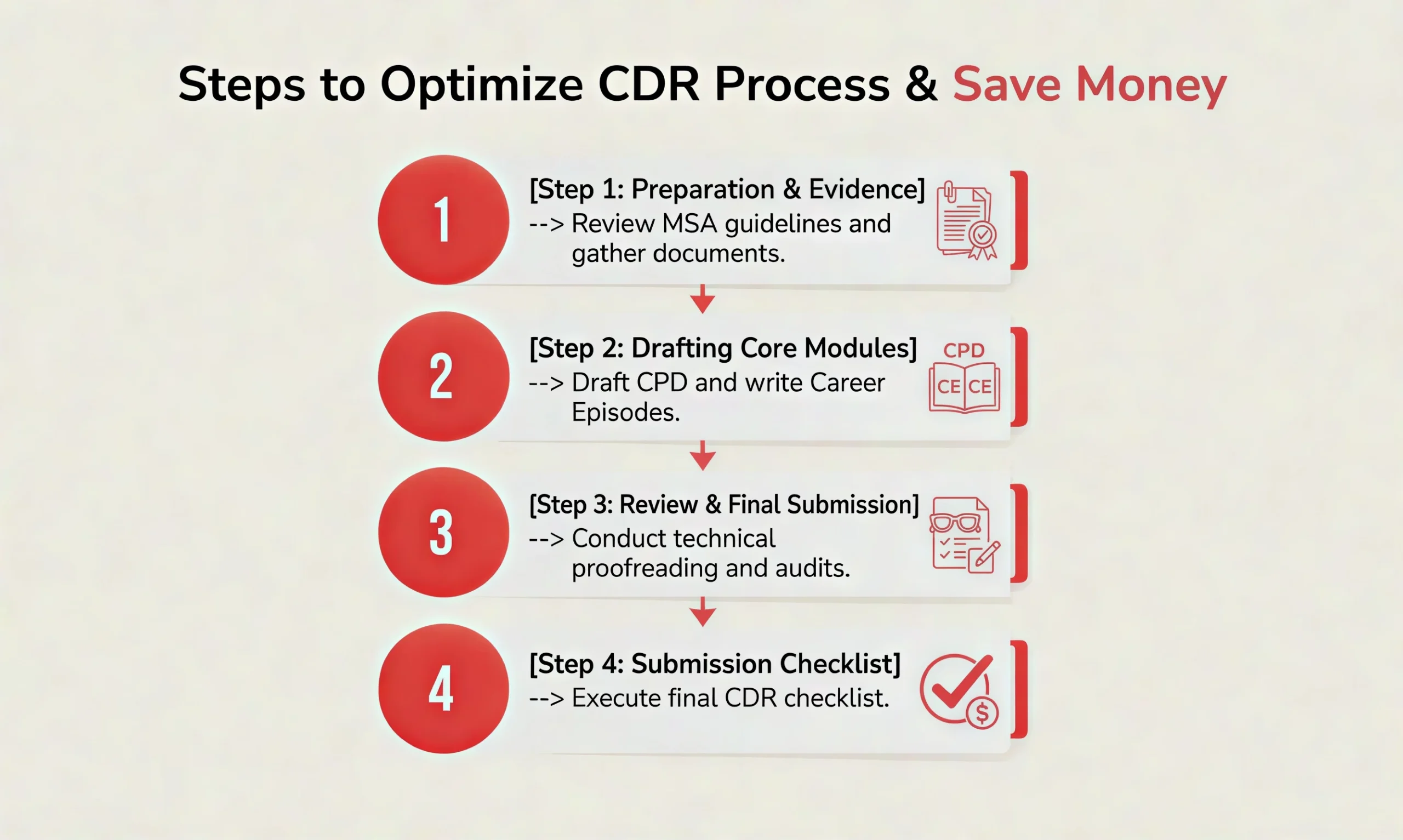
Before writing a single word, establishing a foundation based on Engineers Australia’s Migration Skills Assessment Booklet is critical. Rushing directly into writing without completing the foundational CDR preparation steps often leads to mismatched competency indicators and structural errors. Here is the CDR Report Preparation Timeline reformatted into a clean, well-structured table:
1. Document Collection and Verification
Your CDR report preparation timeline should begin with gathering official documentation. This stage prevents unexpected delays later in the process. Ensure you have:
- Official academic transcripts and degree certificates.
- Updated Curriculum Vitae (CV) formatted to EA standards.
- Proof of English language proficiency (IELTS, PTE Academic, or TOEFL iBT).
- Official employment reference letters for all relevant work experience.
2. Selecting Your Projects for Career Episodes
A common mistake during initial CDR preparation steps is selecting projects based on financial budget rather than personal technical contributions. Engineers Australia evaluates your individual role, not what your team or company accomplished.
- Identify Distinct Projects: Choose three distinct projects that highlight your core skills.
- Match Occupation Code (ANZSCO): Verify that the engineering problems solved in each project match the tasks defined for your nominated ANZSCO code (e.g., Civil Engineer, Mechanical Engineer, Electrical Engineer).
- Personal Contribution: Ensure you played an active technical role (designing calculations, analyzing data, resolving field errors, or testing equipment).
By assigning two weeks in your CDR report preparation timeline to gathering documents and selecting projects, you build a strong foundation for the writing phase.
Phase 2: Drafting Your Core CDR Modules
With project evidence organized, move into the drafting phase. Following structured CDR preparation steps keeps your technical narrative coherent, accurate, and aligned with EA standards.
1. Preparing the Continuing Professional Development (CPD) Statement
Your CPD list demonstrates how you have maintained up-to-date engineering knowledge following graduation. According to EA guidelines, the CPD must be presented in a clear, tabular list including:
- Post-graduate academic study or formal training courses.
- Conferences, seminars, and technical workshops attended.
- Workshops, short courses, or specialized software certifications completed.
- Professional mentoring, journal subscriptions, or technical literature reviews.
Keep descriptions concise; the CPD statement is a clean inventory of your commitment to lifelong engineering learning.
2. Authoring the Three Career Episodes
The three Career Episodes form the core of your report. Each episode details a distinct period of engineering activity and must be written entirely in the first-person singular narrative (“I designed,” “I calculated,” “I investigated”) to emphasize your personal responsibility.
Every episode must follow EA’s mandatory four-section format. Here is the Career Episode Section Structure formatted into a clean, easy-to-read table:
Career Episode Section Structure
- Introduction: Outlines chronological dates, duration, geographic location, employing organization, and your official position title.
- Background: Provides project context, overall objectives, a structural organization chart indicating your position, and your assigned scope of work.
- Personal Engineering Activity: The main technical body. Detail how you applied engineering knowledge, solved complex design challenges, conducted simulations, implemented safety codes, and managed technical risks.
- Summary: Summarizes overall project outcomes and highlights how your individual engineering contributions achieved the client or project goals.
Structuring your writing across a multi-week CDR report preparation timeline allows you to spend 4 to 6 days per Career Episode, ensuring every paragraph is backed by technical details.
3. Constructing the Summary Statement
The Summary Statement links your written Career Episodes to the official Engineers Australia Stage 1 Competencies. It acts as an index for the assessing officer, mapping specific paragraph numbers to competencies such as Knowledge and Skill Base, Engineering Application Ability, and Professional and Personal Attributes.
Writing the Summary Statement requires careful cross-referencing. If your Career Episodes lack specific details (such as risk management or safety compliance), you must return to your drafts and update the text before finalizing your cross-references.
Phase 3: Reviewing, Refining, and Plagiarism Checking
Once initial drafts are complete, transition from author to auditor. The review stage of your CDR report preparation timeline is crucial for converting a basic draft into a fully compliant assessment portfolio. Here is the Three-Tier Review Process formatted into a clean table:
Three-Tier Review Process
Technical and Grammatical Proofreading
Engineering assessments are evaluated on both technical clarity and linguistic precision. Reviewing your work involves key CDR preparation steps:
- Language and Tone: Ensure the text is written in clear, professional Australian English. Avoid overly complex jargon or informal phrasing.
- First-Person Consistency: Verify that all technical activities are described using first-person active voice (“I evaluated,” “I simulated”) rather than passive voice.
- Consistency Check: Confirm that project dates, company names, and job roles match across your CV, reference letters, and Career Episodes.
Eliminating Plagiarism and AI Artifacts
Engineers Australia uses advanced software to screen every submission for plagiarized content and AI-generated text. Borrowing content from online sample CDRs, copying project descriptions from company reports, or generating text with AI tools can result in a rejection and a multi-year ban.
The Master CDR Submission Checklist
Before submitting your application on the Engineers Australia portal, complete this CDR submission checklist to verify that every document meets standard requirements.
Document and Verification Checklist
- Identity Documents: High-resolution color scan of your valid passport bio-page.
- English Proficiency: Official test results (IELTS, PTE Academic, or TOEFL iBT) linked or attached.
- Academic Qualifications: Scanned copies of degree certificates and official transcripts.
- Updated CV/Resume: Comprehensive resume covering your employment history, responsibilities, and key accomplishments.
- Employment Evidence: Official reference letters on official company letterhead for all claimed work experience.
Core CDR Modules Checklist
- CPD Statement: Formatted in a single table with title, date, duration, location, and organizing body.
- Career Episode 1: Formatted into Introduction, Background, Personal Engineering Activity, and Summary.
- Career Episode 2: Covers a separate project, written in the first-person singular.
- Career Episode 3: Demonstrates advanced technical problem-solving and application of engineering standards.
- Summary Statement: All competency indicators correctly cross-referenced to specific paragraph numbers.
Final Quality Assurance Checklist
- Plagiarism Verification: Turnitin audit completed with zero copied content from published sample reports.
- Grammar and Spelling: Document proofread for Australian English spelling, correct punctuation, and active voice.
- Format and File Sizes: All files saved in standard formats (PDF) and under EA file size limits.
Working through this CDR submission checklist gives you confidence that your report is ready for assessment.
Why Professional Assistance Accelerates Your Approval
Managing a CDR report preparation timeline alongside full-time work commitments can feel overwhelming. Balancing complex engineering documentation with strict migration standards leaves little margin for error.
Partnering with experienced migration professionals ensures your report meets Engineers Australia’s criteria. At CDRWritersAustralia.com, we provide specialized services designed for your specific needs:
- Complete CDR Report Writing: End-to-end preparation of your CPD, three Career Episodes, and Summary Statement tailored to your ANZSCO code.
- CDR Review and Editing: Thorough technical and linguistic review by experienced domain specialists to catch errors before submission.
- ACS RPL and KA02 Services: Specialized report writing for IT professionals (ACS RPL) and engineers targeting New Zealand (IPENZ KA02).
- Fast-Track Plans: Structured assistance options (including 15-day, 10-day, and 7-day delivery plans) to help you meet upcoming visa deadlines.
With professional support throughout your CDR preparation steps, you reduce the risk of unexpected RFIs or technical rejections.
Conclusion
Successfully completing your Migration Skills Assessment relies on careful planning, technical precision, and systematic execution. By following a clear CDR report preparation timeline, completing every stage of the CDR preparation steps, and working through the final CDR submission checklist, you present your engineering career in the best possible light.
Whether you are drafting your first project narrative or reviewing your final Summary Statement, careful attention to detail is essential. If you need professional support at any point in your process, the expert team at CDRWritersAustralia.com is ready to help you prepare a compliant, high-quality report.
Frequently Asked Questions (FAQ)
1. How long does a standard CDR report preparation timeline take from start to finish?
A realistic timeline spans 6 to 8 weeks. This duration allows 1 to 2 weeks for gathering academic and employment evidence, 3 to 4 weeks for drafting the CPD, three Career Episodes, and Summary Statement, and 1 to 2 weeks for proofreading, plagiarism auditing, and executing your final submission checks.
2. What are the most critical CDR preparation steps for avoiding an RFI from Engineers Australia?
The most critical steps include:
- Ensuring all Career Episodes are written strictly in the first-person singular (“I designed”, “I calculated”).
- Matching your technical contributions directly to your nominated ANZSCO occupation code.
- Mapping paragraph references in the Summary Statement accurately.
- Conducting an audit to eliminate any potential plagiarism or unverified AI text.
3. Can I use academic projects in my Career Episodes, or must they all be workplace-based?
Engineers Australia allows you to use academic projects completed during your undergraduate or postgraduate engineering studies, particularly if you have limited work experience. However, professional project work is preferred for experienced engineers.
4. Why is a CDR submission checklist necessary before uploading to the EA portal?
Engineers Australia assesses applications based strictly on submitted documents. Omitting a required document, submitting mismatched employment dates, or missing competency elements in your Summary Statement can lead to processing delays, requests for additional information, or rejection.
5. How can CDRWritersAustralia.com assist me if my draft is already finished?
If you have already written your draft, our CDR Review and Proofreading Services can help polish your submission. Our expert technical team reviews your draft against current Engineers Australia guidelines, corrects grammatical and formatting errors, checks Summary Statement cross-references, and performs an advanced plagiarism check to confirm your report is submission-ready.
Get Your CDR Draft Reviewed by Experts Today!
Don’t risk your migration goals with unverified drafts. Contact our expert team now for a free initial evaluation and personalized consultation.