
CDR Rejection Due to Plagiarism: Causes, Legal Implications, and How to Recover
CDR Rejection Due to Plagiarism: Causes, Legal Implications, and How to Recover
 choigen
Securing a positive migration skills assessment from Engineers Australia (EA) is one of the most vital milestones for overseas-trained engineers applying for skilled migration visas (such as Subclasses 189, 190, and 491).
The Competency Demonstration Report (CDR) serves as the legal and technical backbone of your application, proving that your engineering knowledge, core competencies, and professional experience match Australian standards.
However, the risk of a CDR rejection due to plagiarism remains one of the primary obstacles faced by international applicants. Engineers Australia enforces a strict zero-tolerance policy regarding academic dishonesty and copied work.
If you are currently preparing your application or have received an official notice regarding a plagiarism CDR, understanding the underlying causes, detection mechanisms, and recovery options is essential.
3 Key Highlights
- Severe Penalties for Unoriginal Reports: A CDR rejection due to plagiarism leads directly to a 12- to 36-month submission ban by Engineers Australia (EA), along with potential reporting to the Department of Home Affairs.
- Complex Detection Mechanisms: Modern CDR plagiarism rejection triggers stem not only from directly copied online samples, but also from AI content generation tools, shared academic templates, and self-plagiarism across previous submissions.
- Strategic Recovery & Professional Remedies: Overcoming a plagiarism-related CDR ban or an intent-to-reject notice requires a thorough and completely original rewrite of your Career Episodes, Summary Statement, and CPD Report.
Understanding the Competency Demonstration Report (CDR) Framework
Before looking into how a CDR rejection due to plagiarism occurs, it is critical to review the foundational components of a CDR submission as required by Engineers Australia’s Migration Skills Assessment (MSA) guidelines.
A complete CDR consists of three main elements:
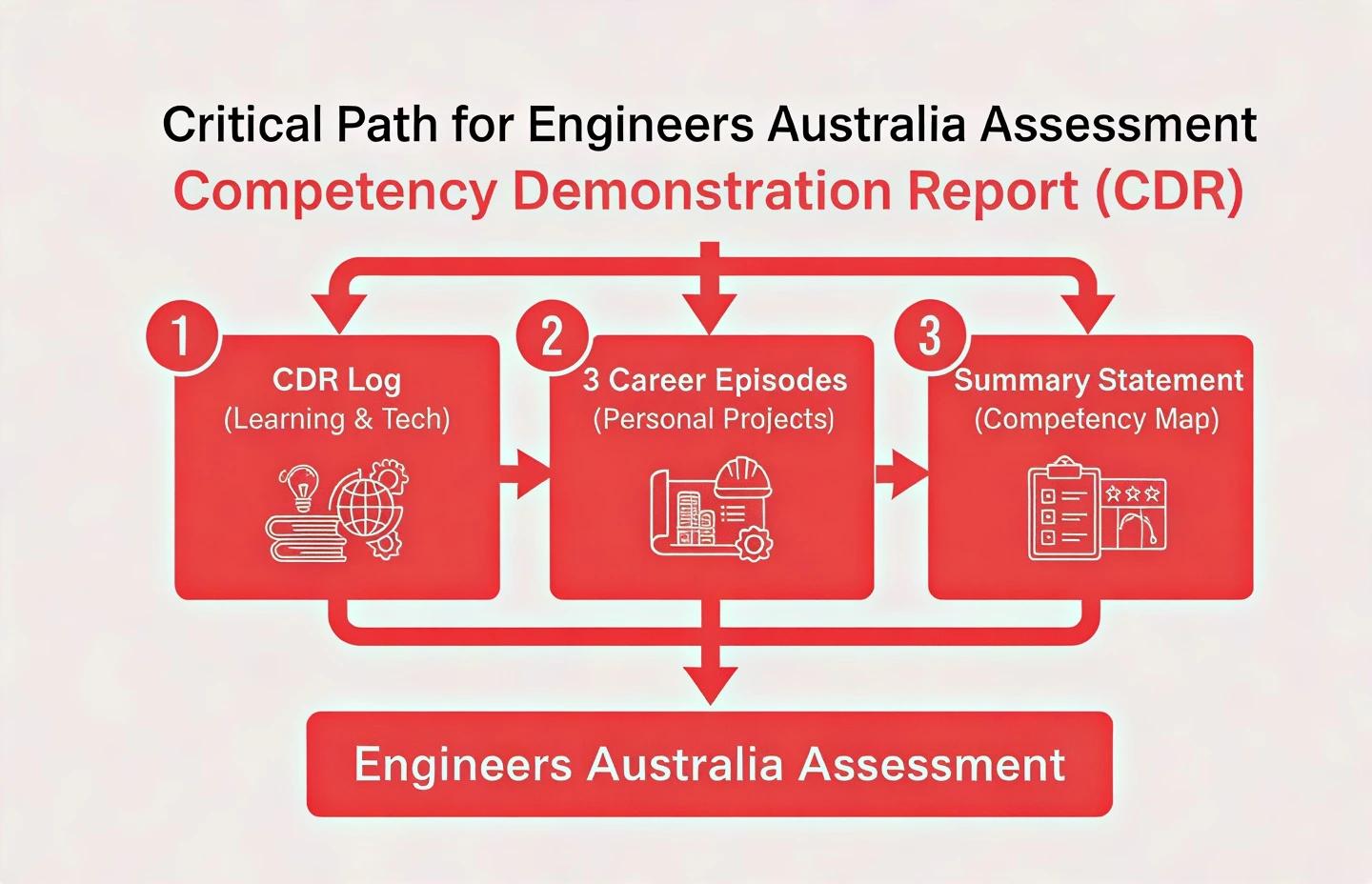
Continuing Professional Development (CPD): A structured log listing your post-qualification learning, technical seminars, higher education, training workshops, and professional involvement.- Three Career Episodes: Detailed, narrative-style technical reports written in the first person (“I designed,” “I calculated,” “I managed”) that highlight specific engineering projects or tasks you personally completed.
- Summary Statement: A cross-referencing matrix that links the competency elements described in your Career Episodes to the specific units required for your ANZSCO occupational classification (such as Professional Engineer, Engineering Technologist, or Engineering Associate).
Because the entire report must demonstrate your personal engineering application and decision-making, every document must be completely unique. Submitting copied text directly violates Engineers Australia’s Code of Ethics.
The Primary Causes of CDR Rejection Due to Plagiarism
A CDR rejection due to plagiarism rarely happens in a vacuum. Applicants often fall into predictable traps during report drafting. Identifying these causes helps you avoid critical errors before submitting your report to Engineers Australia.
| Primary Cause of CDR Plagiarism | Description |
| Direct Sample Copying | Copying text, calculations, or structures from downloadable online samples or project reports. |
| Over-reliance on AI Tools | Using ChatGPT or AI writers that produce generic or recycled phrasing that may be flagged by plagiarism or AI-detection systems. |
| Unintentional Self-Plagiarism | Reusing material from your own previous academic theses or prior Engineers Australia submissions without sufficiently rephrasing it. |
| Uncredited Teamwork Text | Describing group project achievements using team documentation rather than clearly presenting your individual actions using “I.” |
1. Directly Copying Online CDR Samples
Many candidates download “free CDR samples” or purchase pre-written CDR templates online to use as references. While reviewing samples can help you understand the format and tone, directly copying text or problem statements results in an immediate CDR plagiarism rejection.
Engineers Australia maintains an extensive, cross-border database of every CDR sample ever published, sold, or submitted globally. When an assessor runs your file through specialized cross-matching software, any matching paragraphs instantly flag your application.
2. Over-Reliance on AI Text Generators (ChatGPT & Generative AI)
With the rapid growth of artificial intelligence, many applicants use AI models to write their Career Episodes or Summary Statements. However, using generic AI output presents severe risks:
- AI tools draw from existing online data, producing predictable pattern structures that trigger advanced Turnitin-style detectors.
- Generative tools produce generic engineering statements that lack personal context, specific problem-solving details, and accurate engineering evidence.
- EA assessors use AI detection algorithms specifically tuned to identify synthetic text structures.
Relying on artificial intelligence to generate your engineering episodes is one of the fastest paths to receiving an official notice for a plagiarism CDR.
3. Self-Plagiarism and Academic Thesis Reuse
Self-plagiarism occurs when an applicant reuses text from their own past academic publications, master’s theses, or a previously rejected submission without rewriting the content into the required first-person format.
Engineers Australia requires all Career Episodes to be written freshly for the migration skills assessment. Copying large blocks of text from published academic papers or old engineering project reports triggers duplicate content flags.
4. Overlapping Project Work with Colleagues
If you and a university classmate or workplace colleague worked on the same engineering project, submitting Career Episodes that share identical wording, calculations, system diagrams, or narrative structures will trigger a CDR rejection due to plagiarism.
Engineers Australia does not assess what your team achieved; they strictly assess what you individually designed, calculated, analyzed, and implemented. Even if the project was a genuine joint effort, your narrative must be written independently, highlighting only your distinct responsibilities.
How Engineers Australia Detects a Plagiarism CDR
Engineers Australia uses advanced, multi-layered verification procedures to maintain the integrity of the Australian skilled migration system.
1. Proprietary Software and Cross-Institutional Databases
EA utilizes industry-leading plagiarism detection platforms equipped with custom algorithms tailored specifically for technical reports. Their database includes:
- Every CDR ever submitted to Engineers Australia.
- Published academic journals, IEEE papers, conference proceedings, and university repositories.
- Content indexed across public websites, engineering blogs, and commercial sample providers.
- Archived submissions from other migration and assessing authorities.
2. Manual Inspection by Technical Assessors
In addition to automated scanning, experienced EA assessors manually evaluate every report. These technical experts know standard engineering terminology and can easily identify red flags such as:
- Sudden shifts in writing style, vocabulary, or technical depth.
- Vague, overly generalized explanations lacking specific calculations, project locations, software tools, or company details.
- Inconsistencies between claims made in the Career Episodes and the corresponding employment reference letters.
Consequences of Receiving a CDR Plagiarism Rejection
The consequences of an unoriginal submission extend far beyond a simple request for revision. Engineers Australia enforces severe administrative and legal penalties for fraudulent or plagiarized applications.
| Consequence of CDR Plagiarism | Description |
| Immediate Rejection | The application may be marked as unsuccessful, with an official rejection letter issued. |
| 12 to 36-Month Ban | A prohibition on re-applying to Engineers Australia (EA) for a specified period, potentially up to three years. |
| Home Affairs Notification | The matter may be referred to Australian immigration authorities, potentially creating visa-related concerns under relevant provisions such as PIC 4020. |
| Financial Losses | Assessment fees already paid to EA may not be recoverable. |
1. Submission Ban (12 to 36 Months)
If Engineers Australia determines that your report contains copied or fraudulent material, they will issue a CDR rejection due to plagiarism alongside a formal ban. Ban durations typically range from 12 to 36 months, depending on the severity of the violation. During this ban period, you are strictly prohibited from lodging any new skills assessment applications with EA.
2. Department of Home Affairs (Immigration) Reporting
When an application is rejected for dishonesty, EA notes the decision against your name and passport number. This creates severe complications for future visa applications, as providing misleading information to an assessing authority can trigger Public Interest Criterion 4020 (PIC 4020), resulting in potential visa refusals and long-term entry bans to Australia.
3. Financial and Career Delays
A ban effectively halts your Australian migration plans. Beyond forfeiting the initial assessment fees (which exceed AUD 900), the 1 to 3-year delay can cause you to lose points for age on your visa application or miss out on specific state nominations.
How to Respond to an Engineers Australia Intent-to-Reject Notification
Engineers Australia often sends an initial Intent to Reject letter (also known as a Comment or Notice of Adverse Findings) before imposing a formal ban. This letter gives you a short window (typically 14 to 30 days) to respond or explain the detected similarities.
If you receive an Intent to Reject notice for a plagiarism CDR, follow these steps immediately:
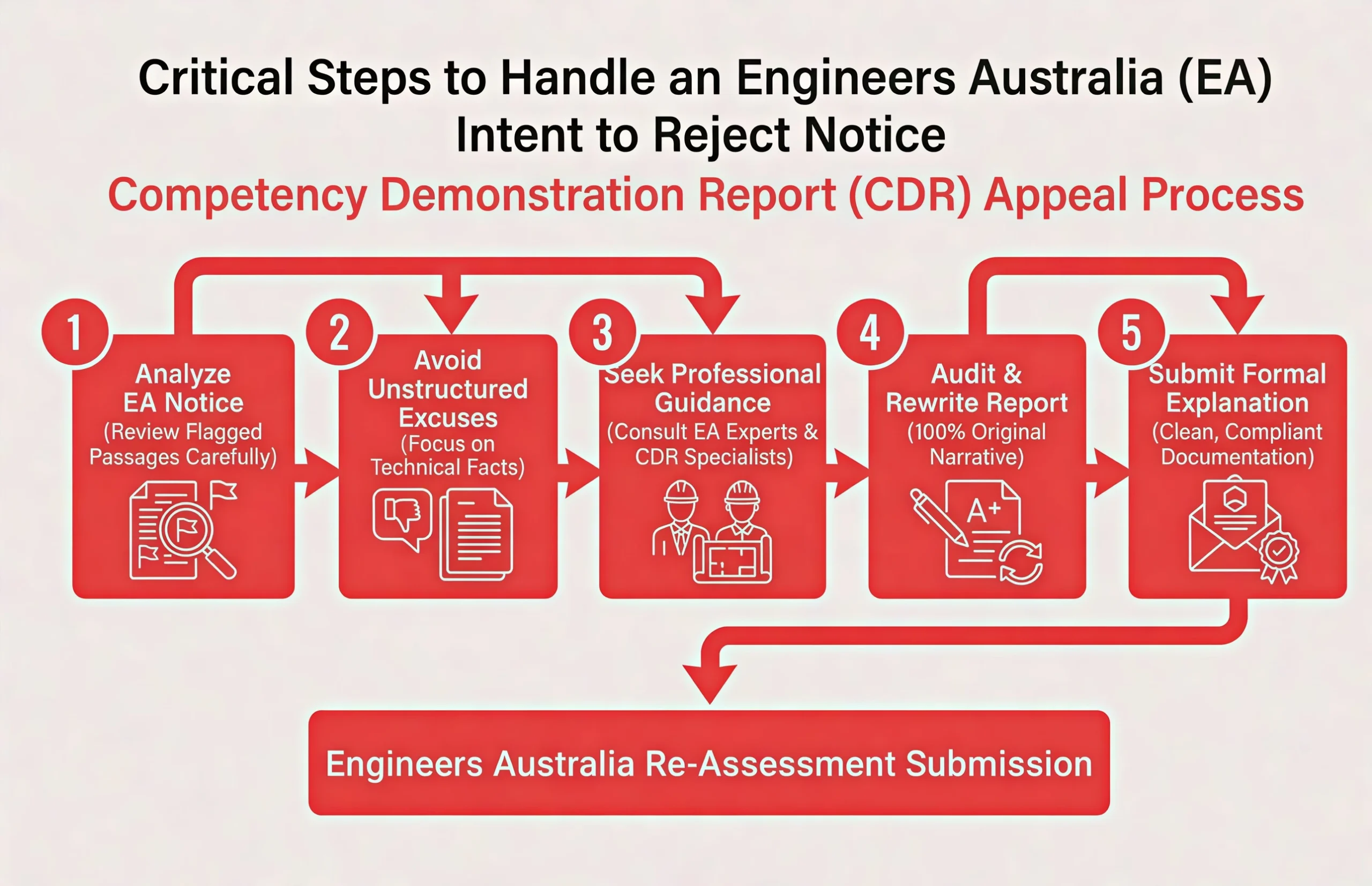
Step 1: Analyze the Assessor’s Specific Feedback
Carefully read the letter to identify which parts of your report were flagged. EA usually highlights matched content, cited sources, or specific reasons why the narrative appears copied or AI-generated.
Step 2: Do Not Submit a Rash or Emotional Response
Avoid sending quick email apologies or defensive arguments without supporting evidence. Claiming “I didn’t know,” “A third party wrote it for me,” or “It was an accident” will not excuse the violation and can guarantee a 12-month ban.
Step 3: Seek Professional CDR Review
Navigating an Intent to Reject notice requires professional intervention. The experts at CDR Writers Australia specialize in auditing flagged reports, removing duplicate content, and restructuring applications to meet EA’s strict integrity guidelines.
Step 4: Complete a Comprehensive Rewrite
If allowed by the assessor, you must rewrite the affected Career Episodes, CPD Report, and Summary Statement from scratch. Ensure that every project detail, calculation, and sentence reflects your personal engineering tasks in your own unique voice.
How to Prevent a CDR Rejection Due to Plagiarism
Prevention is always better than trying to recover from an official ban. Following a disciplined, systematic drafting process guarantees that your submission remains 100% original, professional, and fully compliant with EA standards.
1. Write Exclusively in the First Person (“I”)
Focus entirely on your personal role within every project. Instead of writing general descriptions like:
Write personal, actionable narratives like:
Focusing on your individual actions reduces generic phrasing and eliminates overlapping text.
2. Use Personal Engineering Projects
Never invent projects or adapt work done by others. Base your Career Episodes strictly on real tasks you completed during your university degree or professional career. Keep your original design notes, field logs, site photos, and calculation sheets on hand to verify your writing.
3. Avoid Using Online Samples as Templates
Use CDR samples solely to understand structural layout, formatting, and section ordering. Once you understand the required layout, close the sample documents and draft your own narrative independently.
4. Run Advanced Plagiarism and AI Audits
Before submitting your application to Engineers Australia, conduct thorough quality checks using reliable detection tools. Ensure that your final text shows 0% plagiarized content and contains no AI-generated artifacts.
Professional Services from CDR Writers Australia
Writing an original, high-quality CDR while managing work and personal commitments can be challenging. CDR Writers Australia provides complete end-to-end guidance to ensure your skills assessment documents are fully original and compliant with Engineers Australia requirements.
| CDR Writers Australia Services | Description |
| Full CDR Report Preparation | End-to-end preparation of 3 Career Episodes, CPD, and Summary Statement tailored to your ANZSCO code. |
| Plagiarism & AI Auditing | Advanced scanning, technical editing, and original rewriting of flagged content. |
| Career Episode Writing | In-depth narrative development highlighting your individual engineering contributions. |
| Summary Statement Mapping | Precise cross-referencing of competency elements against Engineers Australia standards. |
| Stage 1 & Stage 2 EA Guidance | Support for standard skills assessment, NER, and Chartered Engineer pathways. |
Comprehensive CDR Preparation
Our tailored CDR for Australia packages include everything needed for a successful assessment:
- Career Episodes Report Writing: Three unique, deeply technical episodes based on your personal academic and professional work experience.
- Summary Statement Report Writing: Accurate alignment of your career achievements with Engineers Australia’s required competency elements.
- CPD Report Writing: A clean, professionally organized record of your ongoing professional development.
Specialized Plagiarism Removal and Review
If you have drafted your own report and want total peace of mind before submitting, our consultants offer detailed review and plagiarism removal services. We run your text through advanced technical detectors, identify matching sentences or synthetic patterns, and rewrite flagged sections while preserving your technical engineering facts.
Support Across Engineering Specializations
Our technical writers cover all major engineering disciplines under ANZSCO units, including:
- Civil Engineers (ANZSCO 233211)
- Mechanical Engineers (ANZSCO 233512)
- Electrical Engineers (ANZSCO 233311)
- Electronics Engineers (ANZSCO 233411)
- Software Engineers & Telecommunications (ANZSCO 263311 / 261313)
- Industrial, Chemical, and Mining Engineers
Additional Skilled Migration Services
Beyond Engineers Australia CDRs, CDR Writers Australia offers expert preparation for other assessing authorities and registration pathways:
- ACS Skill Assessment & RPL Writing Services: Skill assessment support for IT professionals submitting to the Australian Computer Society.
- KAO2 Report Writing: Custom report creation for Engineering New Zealand (IPENZ).
- NER Australia & Stage 2 Chartership: Professional assistance with preparing and organising the required documentation for engineers pursuing NER registration or Chartered recognition through Engineers Australia.
- VETASSESS, TRA, and AITSL Guidance: Comprehensive migration documentation support across various skilled occupations.
Comparing Self-Written, AI-Generated, and Professionally Reviewed CDRs
| Feature / Metric | Self-Written (Unverified) | AI-Generated (ChatGPT/Tools) | Professionally Reviewed (CDR Writers Australia) |
| Plagiarism Risk | Moderate to High (Sample reuse) | Critical / Severe (Predictable AI patterns) | Zero (100% Original Guarantee) |
| First-Person Focus | Mixed (Often uses “We”) | Generic / Narrative-heavy | Strict (“I” centered personal contribution) |
| Competency Mapping | Inconsistent | Vague / Superficial | Precise Summary Statement alignment |
| EA Criteria Compliance | Variable | Fails technical depth checks | 100% Compliant with MSA Guidelines |
| Rejection / Ban Risk | High | Extreme (CDR Plagiarism Rejection) | Minimal (Optimized for First-Time Pass) |
Conclusion
Facing a CDR rejection due to plagiarism is one of the most frustrating setbacks an overseas engineer can experience when applying for Australian skilled migration. The consequences, including a submission ban of up to 36 months and potential visa complications with Home Affairs, make unoriginal submissions a risk no applicant should take.
Avoiding a CDR plagiarism rejection requires a clear strategy: focus exclusively on your real, individual engineering contributions, write in the active first person, avoid using online samples or AI generators as shortcuts, and thoroughly audit your report before submission.
If you want total confidence in your application, partner with the experienced team at CDR Writers Australia. Whether you need end-to-end Career Episode writing, a professional Summary Statement review, or expert support managing an adverse finding, our team provides the guidance needed to secure a positive skills assessment from Engineers Australia.
Frequently Asked Questions (FAQs)
1. What is the main cause of a CDR rejection due to plagiarism?
The primary cause of a CDR rejection due to plagiarism is copying content from online samples, shared project reports, or previously submitted CDRs.
2. Can Engineers Australia detect AI-generated text in a CDR?
Yes. Engineers Australia uses specialized scanning tools and manual assessor reviews designed to detect synthetic content, repetitive structural patterns, and generic technical phrasing typical of AI-generated text.
3. What happens if my CDR is rejected due to plagiarism?
If your application suffers a CDR plagiarism rejection, Engineers Australia will issue an official rejection letter and impose a ban ranging from 12 to 36 months.
4. Can I appeal a CDR rejection due to plagiarism?
You can submit a formal response or appeal if you receive an initial Intent to Reject notice by providing evidence of your personal contributions and submitting rewritten, original content.
5. How much similarity is allowed by Engineers Australia in a CDR?
Engineers Australia maintains a strict zero-tolerance policy for unoriginal work. Unlike academic essays that allow small similarity percentages for cited quotes, a CDR must be 100% original.
6. How can CDR Writers Australia help me avoid plagiarism?
CDR Writers Australia provides complete original report writing, technical editing, and comprehensive plagiarism auditing.