
CDR for Environmental Engineers: Project Evidence and Preparation Guide

CDR for Environmental Engineers: Project Evidence and Preparation Guide
 choigen
Migrating to Australia as an engineering professional requires a well-prepared Competency Demonstration Report (CDR) that reflects your qualifications, technical skills, and practical experience.
For environmental engineers focused on protecting the environment, natural resources, and reducing pollution, a carefully written CDR for environmental engineers is an important step toward meeting Engineers Australia’s assessment requirements and pursuing a career in Australia.
Engineers Australia (EA) assesses your qualifications, technical knowledge, and work experience through your CDR to determine whether they align with Australian engineering competency standards.
Key Highlights
- Rigorous Competency Mapping: You must carefully match your experience as an Environmental Engineer with the Engineers Australia (EA) standards. This involves checking your work history against the required competencies across three Career Episodes.
- Real-World Project Demonstration: Examples such as wastewater treatment plants, site remediation efforts, and environmental impact assessments show that you can handle engineering challenges.
- Plagiarism-Free & Human-Authored Standards: The entire CDR must be written in your words. It should reflect your experience and contributions. Avoid copying text from sources or using templates.
Understanding the Role of an Environmental Engineer in Australian Migration
Environmental engineers play an important role in Australia’s infrastructure development, environmental protection, and sustainability initiatives. Listed under ANZSCO code 233915, Environmental Engineer is a recognised occupation that may provide skilled professionals with opportunities to pursue Australian skilled migration pathways, depending on their qualifications, experience, and eligibility for the relevant visa.
Australia’s varied landscapes and ecosystems create a range of environmental challenges, from securing reliable water supplies during droughts to promoting sustainable mining in remote areas.
Reviewing relevant examples on the CDR Writers Australia website may also help you understand report structure, presentation, and writing style.
Core Components of an Environmental Engineer CDR
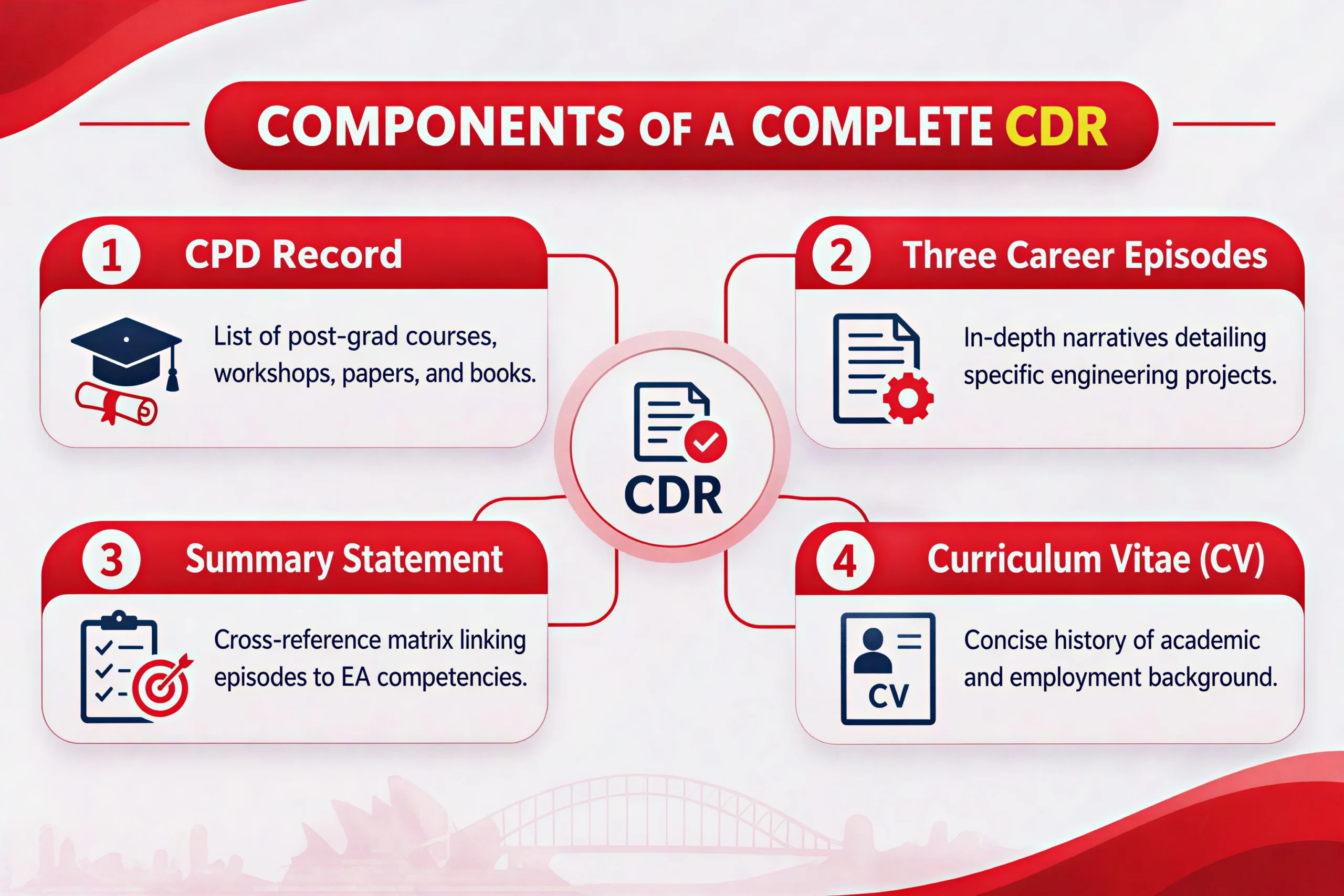
A complete submission mandated by Engineers Australia consists of four major sections: a Continuing Professional Development (CPD) record, three Career Episodes, a Summary Statement, and an updated Curriculum Vitae (CV).
1. Continuing Professional Development (CPD)
Your CPD record is a concise, one-page list that demonstrates how you have kept pace with modern developments in your field. For an Environmental Engineer CDR, this should include:
- Post-graduation courses, seminars, and workshops attended.
- Technical conferences focused on sustainability, green technology, or ecological preservation.
- Books, technical journals, and professional publications read or authored.
- Membership in professional bodies (e.g., Engineers Australia or local environmental engineering societies).
Including recent training in geographic information systems (GIS), life-cycle assessments (LCA), or advanced remediation techniques strengthens the overall impact of your CPD record.
2. Career Episodes
You must submit three Career Episodes, each detailing a distinct phase of your education or professional career. When framing your environmental engineering projects, select tasks that allow you to demonstrate complex problem-solving. Suitable milestones for a CDR for environmental engineers include:
- Designing a wastewater treatment facility or municipal stormwater management network.
- Conducting a comprehensive Environmental Impact Assessment (EIA) for a large-scale infrastructure project.
- Managing a contaminated land remediation project utilizing soil-vapor extraction or bioremediation.
To ensure your narratives flow logically and adhere to EA standards, structure each Career Episode into four standard subsections:
Section 1: Introduction
This section sets the stage by providing the basic administrative intent of the episode:
- Chronological dates and duration of the project.
- Geographical location where the work took place.
- Name of the employing organization or educational institution.
- Your specific job title or project role.
Section 2: Background
The background section explains the overall project context and the circumstances surrounding your individual involvement.
- Overarching objectives and scope of the overall project.
- Nature of the specific engineering problem or challenge.
- A clear description of your assigned role, key responsibilities, and specific duties within the project.
Section 3: Personal Engineering Activity (500–1000 words)
This is the core of the episode where you explain your individual engineering contributions:
- Technical difficulties encountered and your personal approach to overcoming them.
- Details of your design contributions, risk assessment procedures, and measures taken to maintain workplace health and safety.
- Leadership, coordination with stakeholders, and technical decision-making processes.
Section 4: Summary
A brief reflection concluding the narrative:
- Assessment of whether the project met its engineering goals.
- Evaluation of how your personal contributions led to project success.
- Personal learnings and accomplishments from completing the work.
If you find drafting these narratives overwhelming, expert support is available through dedicated career episode writing solutions designed to align your technical history with EA expectations.
3. The Summary Statement
For an Environmental Engineer CDR, competencies are grouped into three primary categories:
- Knowledge and Skill Base: Demonstrating a solid grasp of scientific fundamentals, engineering design concepts, numerical methods, and applicable technical standards.
- Engineering Application Ability: Applying technical knowledge to solve complex environmental issues, executing risk assessments, managing projects, and implementing sustainable design practices.
- Professional and Personal Attributes: Demonstrating ethical conduct, effective communication, team leadership, and professional judgment.
An incomplete or poorly mapped Summary Statement is one of the leading causes of assessment delays or rejections. Ensuring precise cross-referencing for your CDR for environmental engineers is vital for a smooth review process.
Detailed Breakdown of High-Impact Environmental Engineering Projects
Selecting the right project evidence can make or break your application. Engineers Australia wants to see proof of your engineering competency, ethical judgment, and technical aptitude.
Below are three detailed case-study models for environmental engineering projects that translate exceptionally well into high-scoring Career Episodes.
Project Selection Matrix for CDR
| Project Scope | Key Technical Competencies | Software & Analytical Tools |
|---|---|---|
| Urban Hydrology & Stormwater Drainage | Hydrological modeling, runoff calculations, SUDS design | EPANET, HEC-RAS, SWMM, ArcGIS, AutoCAD Civil 3D |
| Wastewater Treatment Plant Upgrade | Biological treatment design, COD/ BOD removal, mass balance analysis | BioWin, GPS-X, MATLAB, Excel Calculation Models |
| Contaminated Land Remediation | Soil sampling, pollutant risk modeling, in-situ treatment design | MODFLOW, ProUCL, Groundwater Vistas, GIS spatial tools |
Case Study 1: Municipal Stormwater Management & Bio-Retention System
- Project Context: Designing a comprehensive urban drainage, detention, and bio-retention network for a 50-hectare residential land development project to mitigate urban flooding and protect downstream natural aquatic ecosystems.
- Engineering Challenges: The primary technical challenge involved managing high peak runoff volumes generated by increased impermeable surfaces while satisfying stringent municipal pollution control regulations regarding sediment, total nitrogen, and phosphorus loads.
- Personal Technical Contributions:
- Carried out hydrological data analysis using historical rainfall intensity-duration-frequency (IDF) curves to calculate design peak discharge rates for 10-year and 100-year storm events.
- Applied Storm Water Management Model (SWMM) software to simulate sub-catchment runoff behavior and optimize the sizing of underground stormwater networks and surface detention basins.
- Designed bio-retention swales and rain gardens, specifying hydraulic conductivity layers, filter media composition, and native vegetation selection to enhance bio-filtration efficiencies.
- Performed structural and hydraulic calculations for inlet structures, weir overflow mechanisms, and energy dissipators using AutoCAD Civil 3D and spreadsheet calculation models.
Case Study 2: Industrial Effluent & Biological Wastewater Treatment Plant Upgrade
- Project Context: Designing a comprehensive urban drainage, detention, and bio-retention network for a 50-hectare residential land development project to mitigate urban flooding and protect downstream natural aquatic ecosystems.
- Engineering Challenges: The facility generated wastewater that was high in strength, with very high and unpredictable levels of Chemical Oxygen Demand (COD), Biological Oxygen Demand (BOD), and total suspended solids (TSS). The upgrade had to be completed without stopping the factory from running.
Case Study 3: Contaminated Land Remediation & Risk Assessment
- Project Context: Preparing and carrying out a cleanup plan for an industrial site affected by petroleum hydrocarbons or heavy metals to make the land suitable for future commercial development.
- Engineering Challenges: The site is at risk of migration toward nearby residential zones when the soil is disturbed.
- Personal Technical Contributions:
- Developed a site-specific environmental assessment sampling plan in accordance with applicable soil investigation guidelines to identify the extent and distribution of contamination.
- Applied MODFLOW groundwater modeling to assess subsurface flow patterns and predict contaminant plume movement under different hydrogeological conditions.
For applicants looking for additional reference models, exploring verified CDR report samples can provide invaluable structural clarity on how to write about these complex technical tasks.
Step-by-Step Writing Guide for Environmental Engineers
Drafting a successful report requires a disciplined approach. Follow this step-by-step methodology to ensure your submission is structured, accurate, and aligned with Engineers Australia expectations:

Step 1: Gather Documentation and Select Projects
Before writing a single paragraph, collect all supporting documentation:
- Project designs, engineering drawings, calculation sheets, and final technical reports.
- Certificates of employment, official job descriptions, and reference letters.
- Select three distinct environmental engineering projects that demonstrate progression in responsibility, technical complexity, and engineering problem-solving.
Step 2: Draft Your Continuing Professional Development (CPD) and CV
Create a professional, well-organized CV highlighting your career progression, engineering expertise, technical software skills, and previous positions. Check that all employment dates are consistent with those mentioned in your Career Episodes.
Step 3: Write Your Career Episodes in sequence
Write each Career Episode separately, using first-person language to describe your own work, such as “I calculated,” “I analyzed,” and “I evaluated.” Number every paragraph consistently, following the format 1.1, 1.2, and 1.3 for Episode 1, then 2.1, 2.2, and 2.3 for Episode 2.
Step 4: Prepare the Summary Statement
After completing all three Career Episodes, fill in the Summary Statement using the appropriate Engineers Australia template. Review each competency indicator in the relevant EA guidelines and link it to the paragraph numbers that demonstrate your skills and knowledge.
Step 5: Proofread, Format, and Verify Originality
Examine your entire CDR portfolio for technical errors, grammatical issues, and inconsistencies in formatting. Run plagiarism checks to identify any matching content and revise sections where necessary.
Critical Pitfalls to Avoid in Your Environmental Engineer CDR
Even experienced professionals can face negative migration outcomes due to avoidable errors.
1. Plagiarism and AI-Generated Content
Engineers Australia reviews CDR submissions for copied material, similarities with published documents, and concerns about the authenticity of the applicant’s work.
2. Overemphasis on Teamwork over Personal Contribution
A common error in environmental engineering projects is describing what “we achieved” or what “the department completed.” EA evaluates your personal capabilities as an individual engineer.
3. Neglecting Safety, Risk, and Environmental Compliance
As an Environmental Engineer, your core mandate centers on sustainability, compliance, and public safety. Failing to mention local environmental regulations, health and safety protocols (HSE), risk management frameworks, or sustainability assessments in your project descriptions creates a significant gap in your competency profile.
4. Excessive Academic Theory Without Practical Application
While academic projects from your final undergraduate or postgraduate studies are valid for Career Episodes, relying purely on high-level theoretical discussions without showing practical design, software application, or real-world problem-solving weakens your report.
5. Inconsistent Information Across Documents
Discrepancies between project dates in your CV, reference letters, and Career Episodes trigger red flags during assessment. Ensure all dates, job titles, project titles, and company details align perfectly across all documents in your submission package.
To mitigate these risks, utilizing comprehensive CDR report writing assistance ensures your documentation undergoes rigorous quality, technical, and plagiarism checks before final submission.
Comparison: Washington Accord vs. Non-Washington Accord Applicants
| Assessment Aspect | Washington Accord Qualifications | Non-Washington Accord / CDR Path |
|---|---|---|
| Primary Evaluation Base | Recognized accredited degree | Detailed CDR Portfolio |
| Career Episodes Required? | Generally Exempt | Mandatory (3 Full Episodes) |
| Summary Statement Required? | Exempt | Mandatory Mapping Matrix |
| Continuing Professional Dev. | Standard CV submission | Detailed CPD Form |
| Processing Rigor & Detail | Fast-track document check | Comprehensive technical review |
If your engineering degree was earned in a country that is a full signatory to the Washington Accord, you may be eligible for a direct assessment pathway based primarily on your qualification.
For non-Accord applicants, the Environmental Engineer CDR serves as your primary opportunity to demonstrate that your education and professional work experience meet Australian equivalency standards.
Conclusion
Achieving a successful migration skills assessment requires careful preparation, technical accuracy, and a clear presentation of your engineering knowledge and practical experience. A strong CDR for environmental engineers highlights your engineering background, skills, and project experience while showing your ability to meet Engineers Australia’s professional competency requirements.
By showcasing your individual achievements in relevant environmental engineering projects, following Engineers Australia’s documentation guidelines, and providing clear evidence of your technical abilities, you can strengthen your CDR and improve your chances of pursuing an engineering career in Australia.
Frequently Asked Questions (FAQs)
1. What is the main purpose of submitting a CDR for environmental engineers?
The goal is to demonstrate to Engineers Australia that your qualifications, technical knowledge, and hands-on experience satisfy the professional competency requirements for an Environmental Engineer.
2. How many Career Episodes must be included in an Environmental Engineer CDR?
You must include exactly three Career Episodes. These should cover distinct periods of your engineering experience, such as an undergraduate major project, an early career assignment, or a recent complex project managed in a professional role.
3. What are the ideal word count limits for each Career Episode?
According to Engineers Australia guidelines, each Career Episode should ideally be between 1,000 and 2,500 words.
4. Can I use AI tools or online templates to write my environmental engineering projects?
It is strongly discouraged. Engineers Australia runs strict plagiarism and AI detection checks on all incoming submissions.
5. What software tools should I mention in my Environmental Engineer CDR?
Depending on your project focus, mentioning widely recognized industry software, such as EPANET, SWMM, HEC-RAS, MODFLOW, ArcGIS, BioWin, or AutoCAD Civil 3D, adds technical depth to your Career Episodes and demonstrates practical engineering competency.