
Why AI-Written CDR rejection Can Fail Engineers Australia Assessment
Why AI-Written CDR rejection Can Fail Engineers Australia Assessment
 choigen
However, relying on AI written CDR drafts or using generative AI to author your application is one of the highest-risk decisions an engineering candidate can make. Engineers Australia (EA), the designated assessing authority for foreign engineering qualifications under the Migration Skills Assessment (MSA) pathway, enforces strict verification protocols including CDR AI detection.
An AI written CDR rejection does not merely delay your visa application; it can permanently alter your professional prospects through multi-year assessment bans or fraud reporting to the Department of Home Affairs.
3 Key Highlights
- Strict Zero-Tolerance Framework & Sophisticated AI Detection: Engineers Australia utilizes advanced text analysis engines alongside specialized CDR AI detection tools to identify synthetic language patterns, uniform perplexity/burstiness metrics, and machine-generated phrasing.
- Structural Incompatibility with MSA Competencies: AI models inherently write from a high-level, passive, or team-centric perspective. An AI written CDR routinely fails to present personal engineering agency (“I” active-voice actions), deep design calculations, and contextual standards required by the MSA Booklet.
- Severe Migration & Professional Consequences: An AI-written CDR rejection or an AI CDR rejection often results in an assessment ban of twelve to thirty-six months. It also leaves a mark on your Australian Department of Home Affairs immigration record.
Understanding the Competency Demonstration Report (CDR) Pathway
To understand why synthetic text triggers an AI CDR rejection, one must first recognize the fundamental purpose of the CDR pathway under the Engineers Australia Migration Skills Assessment (MSA).
When an international engineer applies for Australian skilled migration, EA evaluates whether their qualifications meet the benchmark standards established for Australian engineering categories:
- Professional Engineer (ANZSCO 233211, 233511, 233311, etc.)
- Engineering Technologist (ANZSCO 233914)
- Engineering Associate (ANZSCO 312211, 312311, etc.)
- Engineering Manager (ANZSCO 133211)
For graduates of Washington Accord, Sydney Accord, or Dublin Accord programs, qualification recognition is often streamlined. However, engineers graduating from non-accord tertiary institutions must demonstrate their competencies through the detailed CDR package.
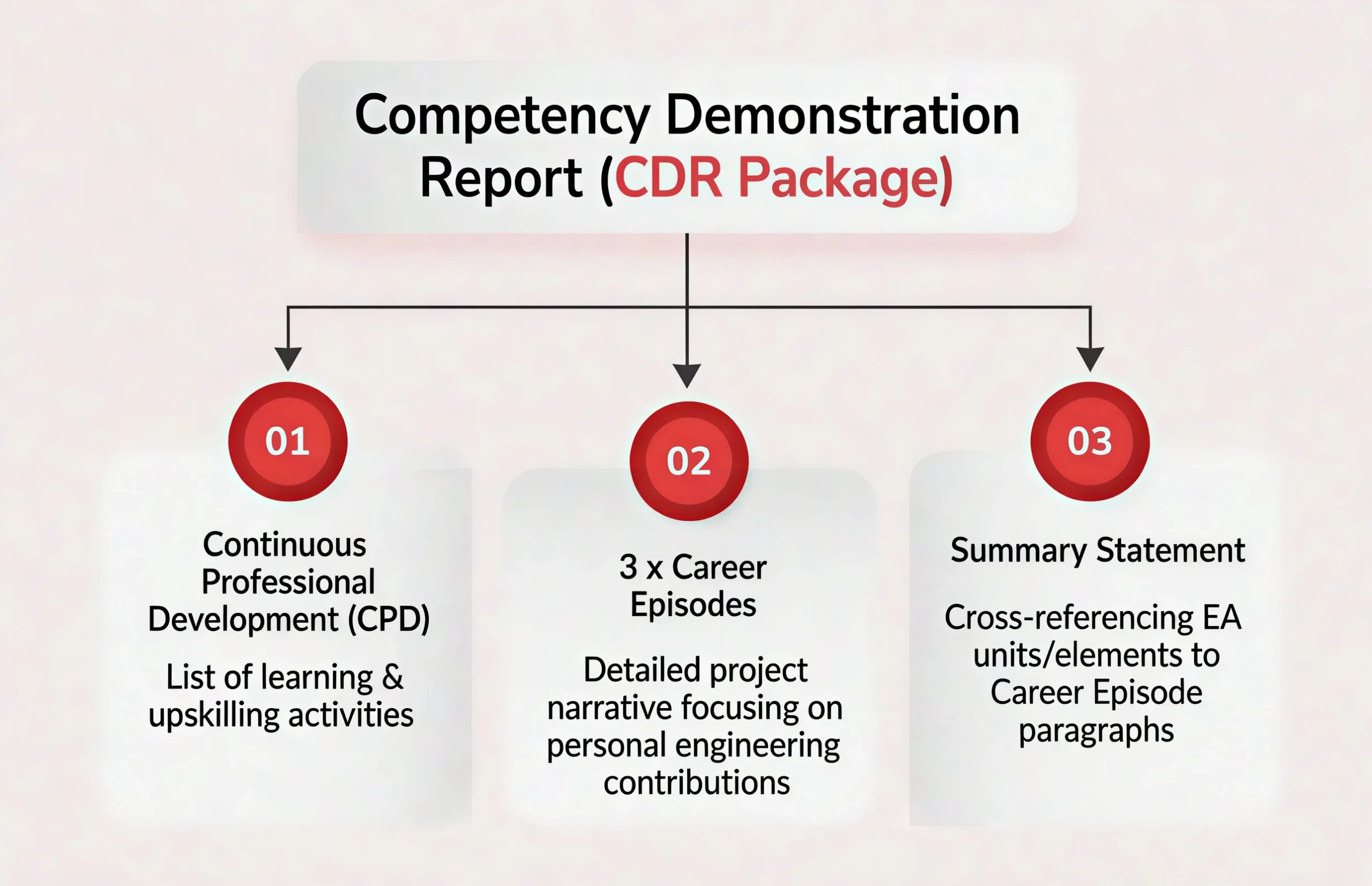
- Continuing Professional Development (CPD): A structured summary listing post-graduation learning, study, technical seminars, and journal readings demonstrating that you remain current in your field.
- Three Career Episodes: Distinct narrative reports based on separate periods of engineering study or work experience.
- Summary Statement: The critical matrix where you explicitly link specific paragraphs from your Career Episodes to competency elements defined in the EA Stage 1 Competency Standards.
The entire report must strictly reflect your personal work and individual contributions. It is not a broad summary of what your company, academic department, or project team accomplished; it is an evidence-based audit of your personal technical capabilities. Relying on an AI written CDR obscures this personal evidence, making an AI CDR rejection almost guaranteed.
The Technology Behind CDR AI Detection
A common misconception among candidates is that generative AI creates human-like text that cannot be traced. Many believe that using sophisticated prompts or minor word substitutions will bypass automated filters and prevent an AI CDR rejection. This misunderstanding overlooks how modern natural language processing (NLP) and CDR AI detection engines operate.
Engineers Australia employs document analysis platforms built specifically to evaluate linguistic predictability, stylistic consistency, and structural anomalies.
1. Perplexity Assessment
Perplexity measures how predictable a word sequence is to a language model. Generative AI models select words based on statistical probabilities, choosing words that logically follow previous ones. Consequently, a CDR written by an AI has low perplexity; it is smooth and easy to predict statistically.
Human writing, by contrast, features unpredictable word choices, idiomatic variations, and non-standard phrasing tailored to a unique situation. CDR AI detection algorithms flag low-perplexity text as statistically unnatural.
2. Burstiness Assessment
Burstiness evaluates variations in sentence length, structure, and complexity across a document. Humans naturally vary sentence structures, following a long, complex technical sentence with a brief, direct statement. Generative AI models produce text with uniform length and repetitive structure. CDR AI detection systems flag low-burstiness patterns immediately.
3. Machine-Learning Classifiers & Forensic Audits
Modern CDR AI detection systems use trained classifiers to recognize structural patterns typical of model outputs, such as repetitive transitional phrases (Furthermore, In conclusion, It is crucial to note that) and uniform paragraph structures.
When automated CDR AI detection flags a document, an experienced EA human assessor conducts a deep forensic review, comparing claims against regional engineering practices, genuine equipment models, and real project timelines.
4 Critical Reasons AI-Written CDRs Fail EA Standards
Understanding the technical mechanisms of CDR AI detection is only half the equation. You must also consider why the actual text produced by AI fails to meet EA’s Stage 1 Competency criteria.
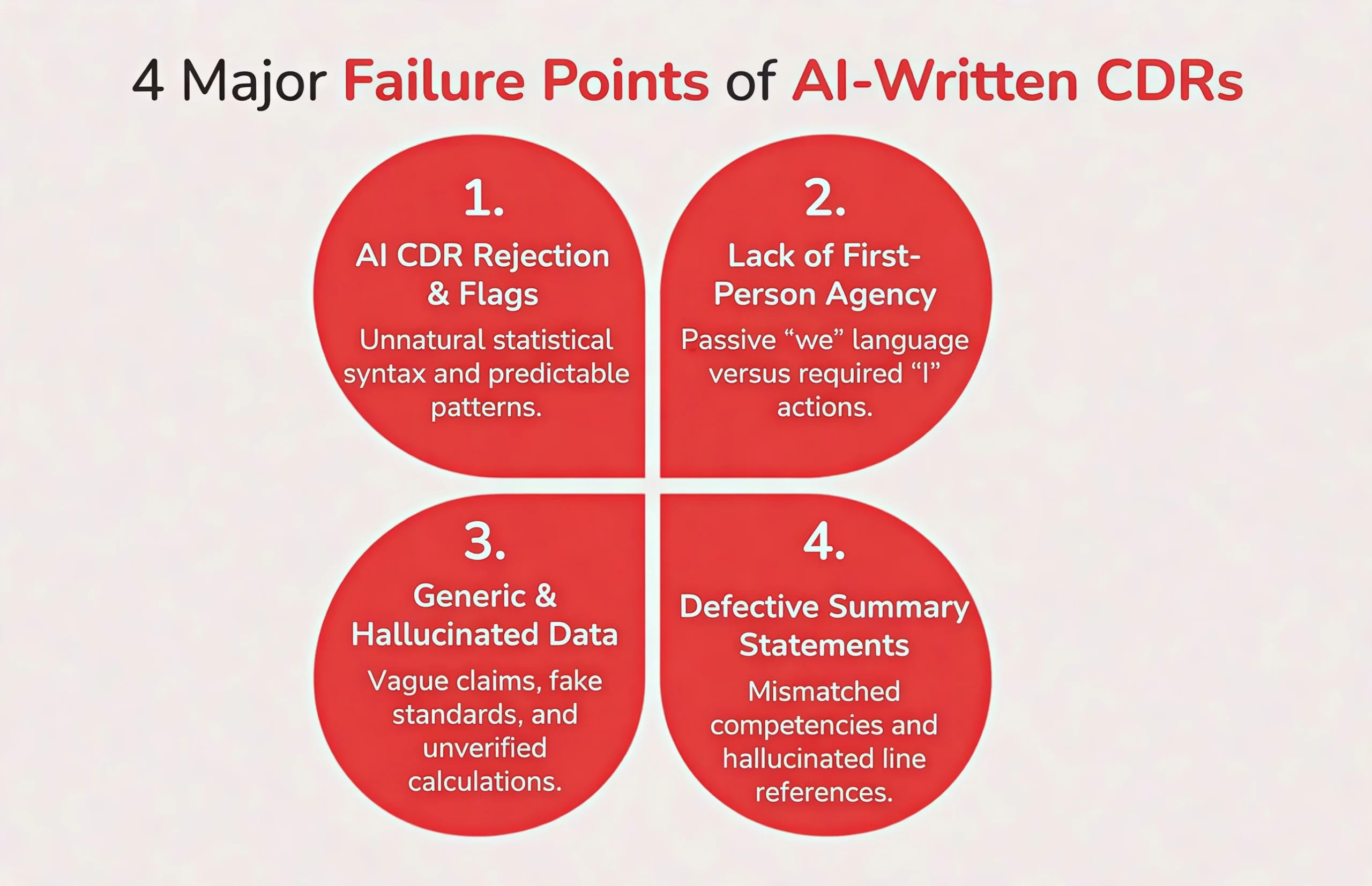
1. Absence of Personal Engineering Agency (“I” vs. “We”)
The Engineers Australia MSA booklet explicitly states that Career Episodes must be written in the first-person singular active voice. Assessors want to know what you did, not what your team did.
- Acceptable Human Writing: “I designed the reinforcement layout for the continuous concrete beam using ETABS, applying AS 3600-2018 standards to ensure flexural capacity met the required design loads.”
- Typical AI Output: “The engineering team ensured structural integrity by utilizing industry-standard software and applying relevant design codes to verify that the beam capacity was sufficient.”
When prompted, AI defaults to team-oriented or passive constructions (“The project was implemented…”). When forced to write using “I”, AI generates superficial claims (“I optimized the system to make it better”), omitting the personal step-by-step reasoning EA assessors demand. This failure directly causes AI written CDR rejection.
2. Generic Technical Claims and “Hallucinated” Data
Engineers Australia requires specific, documented evidence of your personal technical contributions, including exact mathematical formulas, software modules used, Australian Standards applied (e.g., AS/NZS 3000), and real-world physical constraints.
Generative AI cannot recall details from your past projects. Instead, an AI written CDR generates plausible-sounding technical filler. This vague phrasing provides zero technical evidence, triggering an immediate AI CDR rejection. Furthermore, AI models frequently hallucinate non-existent standards (e.g., “According to AS 9999-2022 guidelines…”) or misapply engineering principles, alerting assessors to artificial generation.
3. Defective Competency Mapping in the Summary Statement
The Summary Statement translates your Career Episodes into the structured format required by EA’s Stage 1 Competencies. You must map specific paragraphs to competency indicators across Knowledge Base, Engineering Application Ability, and Professional Attributes.
When generating an AI written CDR Summary Statement, AI routinely maps paragraphs containing no relevant evidence to complex technical indicators or generates incorrect paragraph numbers. When an assessor finds no supporting evidence at the cited location, an AI written CDR rejection is issued.
4. Style Inconsistencies and Structural Repetition
AI models follow uniform structural templates. When asked to write three Career Episodes, AI typically uses the exact same outline for all three: an introduction, three broadly described problems with immediate solutions, and a generic conclusion.
Real-world engineering projects feature complex challenges, changing scopes, site constraints, and trade-offs. The polished, uniform structure of an AI written CDR signals artificial generation to evaluators.
Consequences of Submitting an AI-Generated CDR
Attempting to shortcut the CDR process with AI tools carries severe consequences enforced by Engineers Australia.
1. Immediate AI CDR Rejection and Loss of Fees
If EA determines that your CDR contains uncredited AI-generated content or plagiarized material, your application faces an immediate AI CDR rejection. Assessment fees are non-refundable, and processing time is lost.
2. Formal Application Bans (12 to 36 Months)
If you submit an AI written CDR flagged by CDR AI detection, EA issues a formal show-cause letter. If your response fails to disprove the finding, EA can impose a formal assessment ban ranging from 12 to 36 months, during which you are barred from re-applying.
3. Reporting to the Department of Home Affairs
Engineers Australia works closely with the Australian Department of Home Affairs (DHA). A record of fraudulent submission can lead to visa refusals under Public Interest Criterion (PIC) 4020, resulting in a 3-to-10-year ban on applying for Australian visas.
Comparison: AI-Generated vs. Compliant Human CDRs
| Assessment Dimension | AI Written CDR | Authentic Human CDR (Professional Services) |
| Primary Language Focus | Generic, passive, team-based (“The team optimized…”) | Active, first-person singular (“I calculated the peak load…”) |
| Technical Depth | High-level summaries without formulas or exact parameters | Specific equations, load calculations, and software parameters |
| Standards & Codes | Missing, generalized, or hallucinated codes | Exact Australian and international standards cited accurately |
| CDR AI Detection Risk | Extremely High (Triggers AI CDR rejection) | Zero Risk (100% original, human-crafted writing) |
| Summary Statement | Generalized mapping with frequent reference errors | Precise cross-referencing matching narrative evidence directly |
| Problem Solving | Generic problems solved effortlessly without trade-offs | Detailed account of real site constraints and trade-offs |
Proper Role of Tools vs. Prohibited AI Generation
Engineers Australia distinguishes between appropriate software assistance and unacceptable AI generation:
- Permissible Use: Basic spelling and grammar checking, document formatting adjustments, and managing reference citations.
- Prohibited Use: Generating narrative paragraphs, paraphrasing existing sample episodes, writing technical summaries, or generating automated Summary Statement mappings. Paraphrasing sample CDRs with AI still triggers both plagiarism and CDR AI detection filters.
How CDR Writers Australia Guarantees 100% EA Approval
Navigating the technical and stylistic requirements of Engineers Australia can be challenging, especially for applicants writing in English as an additional language. Many applicants fall into the trap of submitting an AI written CDR out of fear that their natural English vocabulary is insufficient.
However, Engineers Australia values technical clarity, accuracy, and genuine personal evidence over complex vocabulary. A cleanly written, grammatically simple report based on genuine personal work will pass assessment, while an AI written CDR risks immediate rejection and bans.
At CDR Writers Australia, our mission is to eliminate the threat of an AI CDR rejection through custom-tailored preparation and auditing services:
- Complete CDR Writing Services: We craft customized, end-to-end Competency Demonstration Reports (3 Career Episodes, Summary Statement, and CPD) built 100% from your authentic engineering experience.
- Professional CDR Reviewing Services: Our experts conduct rigorous structural, technical, and CDR AI detection checks to eliminate synthetic phrasing, fix competency mapping, and guarantee full alignment with EA guidelines.
- Domain-Specific Engineering Experts: Your CDR is handled by certified engineering consultants in your exact discipline (Civil, Mechanical, Electrical, IT/Software, Chemical, Biomedical) who understand specialized industry terms and standards.
- Related Migration Skill Assessments: We also provide specialized documentation services for ACS RPL Report Writing for IT professionals and KA02 Knowledge Assessment Reports for Engineering New Zealand.
- Guaranteed Plagiarism & AI-Free Content: Every document passes comprehensive similarity and CDR AI detection software audits prior to delivery, ensuring your submission is 100% original and audit-safe.
Conclusion
The temptation to use AI tools for drafting a Competency Demonstration Report is understandable given the scope of work required. However, the operational reality of Engineers Australia’s assessment process makes relying on an AI written CDR an unacceptable risk.
With advanced CDR AI detection tools, strict zero-tolerance policies, and human evaluators reviewing your work, submitting synthetic text frequently leads to an AI written CDR rejection, an AI CDR rejection, formal application bans, and severe migration penalties.
To secure your Australian skilled migration with a 100% human-crafted, plagiarism-free, and EA-compliant report, contact the expert team at CDR Writers Australia today.
Frequently Asked Questions (FAQ)
1. Does Engineers Australia use AI detection tools for CDR assessment?
Yes. Engineers Australia uses advanced CDR AI detection software alongside traditional plagiarism analysis platforms to evaluate submitted CDR packages. These systems analyze text for statistically uniform sentence patterns, artificial perplexity/burstiness levels, and machine-generated phrasing.
2. What happens if my report gets an AI CDR rejection?
If EA’s detection systems and human assessors confirm that you submitted an AI written CDR, your application faces an immediate AI CDR rejection. You face a formal 12-to-36-month ban from the Migration Skills Assessment pathway, and EA may report the finding to the Department of Home Affairs under fraud prevention guidelines.
3. Can I use AI tools like ChatGPT to polish my grammar or structure?
Using standard word processor spell-checking tools is fine, but using generative AI to rewrite, rephrase, or expand technical descriptions is highly risky. AI rewriting tools routinely inject predictable statistical patterns that trigger CDR AI detection filters and lead to an AI written CDR rejection.
4. How can I fix an AI-flagged CDR draft before submitting it?
You cannot fix an AI written CDR by simply swapping words or running it through an AI “humanizer” tool (which creates additional synthetic patterns). You must discard the AI draft entirely and rewrite your Career Episodes from scratch using your personal project notes, real design data, and active first-person phrasing (“I designed”, “I calculated”).
5. Why do AI tools fail to write effective Summary Statements?
AI tools struggle with whole-document semantic context. In an AI written CDR, AI engines routinely map Stage 1 Competency elements to irrelevant narrative paragraphs or generate incorrect paragraph numbers, leading EA assessors to issue an AI CDR rejection.